2026-10-20 カリフォルニア大学サンディエゴ校(UCSD)
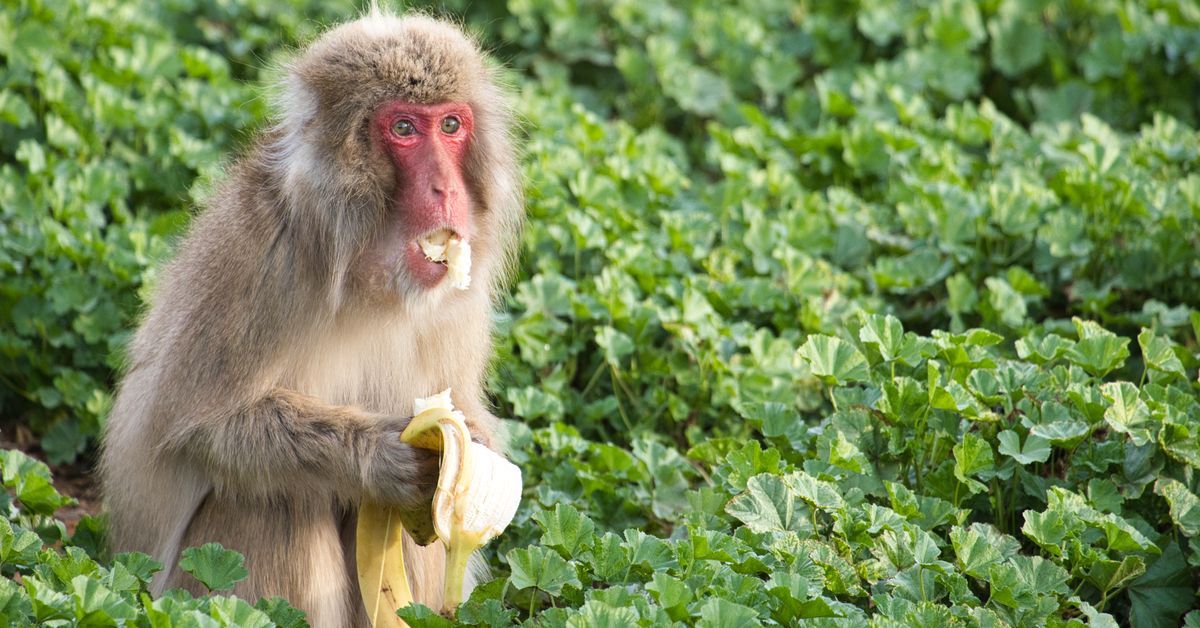
A Japanese macaque eats a banana. Credit: UC San Diego.
<関連情報>
- https://today.ucsd.edu/story/like-humans-some-primates-become-cautious-of-germs-in-the-wake-of-a-viral-outbreak
- https://royalsocietypublishing.org/rsos/article/13/10/260011/483776/Early-life-experience-and-disease-exposure-affect
幼少期の経験と疾病への曝露は、マカクザルの病原体回避行動に影響を与える Early-life experience and disease exposure affect pathogen avoidance behaviour in macaques
Stephan P. Kaufhold;Amanda Goguen;Kyliegh Viano;Federico Rossano
Royal Society Open Science Published:21 Oct 2026
DOI:https://doi.org/10.1098/rsos.260011
Abstract
Pathogens exert strong selective pressure on group-living primates. In humans, disease defence includes both a biological and behavioural immune system, which includes the emotion of disgust and avoidance behaviours shaped by genetics, learning and culture. While pathogen avoidance is documented in nonhuman primates, little is known about how ecological and developmental factors influence pathogen sensitivity, that is, individual variation in pathogen avoidance. We conducted two studies to examine this in macaques. Our first study tested macaques (n = 54) from seven different species and four different rearing backgrounds in a visual food-choice task where food was either placed on a substrate with or without pathogenic cues. Macaques preferred feeding on non-contaminated substrates, with sanctuary-born individuals showing greater avoidance than former pets. Our second study tested sanctuary-born Japanese macaques (n = 55) from four groups; three groups had recently experienced an infectious disease outbreak. Macaques from exposed groups showed significantly higher avoidance of contaminated substrates. Together, our findings suggest that early life rearing experience and recent disease exposure shape pathogen sensitivity in macaques, demonstrating a flexible behavioural immune system in Old World monkeys. These findings suggest that flexible, context-sensitive pathogen avoidance is present in Old World monkeys, providing the behavioural foundations from which human disgust may have evolved.