2026-11-12 国立遺伝学研究所
国立遺伝学研究所、九州大学などの研究グループは、マウスの初期胚において、細胞核が一時的に軟らかくなることが、胚性ゲノム活性化(ZGA)に重要な役割を果たすことを明らかにした。独自開発のナノキャピラリーを用いて生きた初期胚の核の物性を直接測定した結果、受精後の2細胞期に核が軟らかく、変形しやすい状態になることを発見した。この変化には、核構造を支えるラミンB1タンパク質がオートファジー因子LC3を介して核膜から除去される機構が関与していた。さらに、核の軟化によって遺伝子の核内配置が変化し、大規模な遺伝子活性化が促進されることを実証した。加えて、核の硬さを人工的に制御する分子デバイスも開発した。本成果は、細胞核の物理的性質が遺伝子発現と初期胚発生を制御するという新たな概念を示し、発生生物学や生殖医療の研究への応用が期待される。
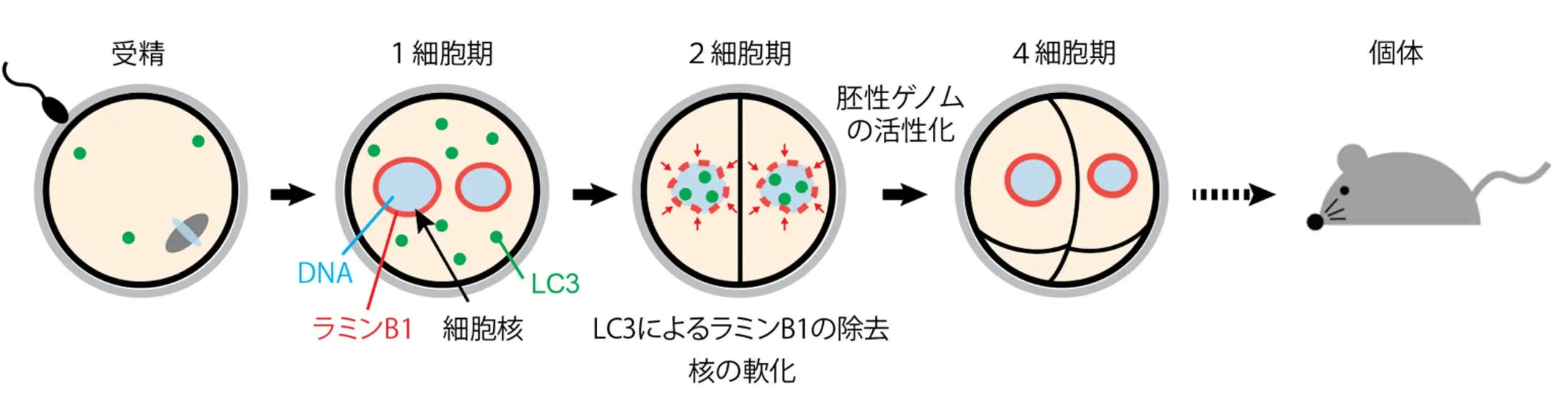
図1:核の一時的な軟化による胚性ゲノム活性化と胚発生の促進
<関連情報>
マウスにおける接合子遺伝子活性化のための核の一過性軟化 Transient nuclear softening for zygotic gene activation in mice
Masahito Tanaka, Rin Sakanoue, Yasuki Miyagawa, Kai Otsuka, Yoshiaki Kobayashi, Atsushi Takasu, Ryunosuke Mori, Naoko Watanabe, Akihiro Inoue, Koyo Ikeda, Yu-Chia Chen, Aussie Suzuki, Yasuyuki Ohkawa, So Maezawa, Hiroshi Ochiai, Kei Miyamoto & Yuta Shimamoto
Nature Published:11 November 2026
DOI:https://doi.org/10.1038/s41586-026-11240-w
Tii-summary
哺乳類の初期胚では、受精卵自身のゲノムが働き始める受精卵ゲノム活性化(ZGA)が発生に不可欠であるが、この過程における細胞核の物理的役割は十分に解明されていなかった。本研究では、マウス受精卵を対象に、核の形状観察とナノキャピラリーによる力学測定を行い、2細胞期に核が一時的に軟化し、変形しやすい可塑的状態になることを発見した。この変化は核膜の構造タンパク質ラミンB1が、オートファジー因子LC3によって一時的に除去されることで生じる。ラミンB1の残存や過剰発現によって核を硬い状態に維持すると、3,000以上の遺伝子の発現が低下し、ZGAが不完全となり、胚の約半数が2細胞期で発生停止した。また、核を人工的に硬くする実験でも、主要なZGA関連遺伝子の発現抑制が確認された。さらに、軟らかい核ではRNAポリメラーゼIIの集積や重要なゲノム領域の配置が促進され、遺伝子転写が活発化することが示された。本研究は、核の物理的柔軟性が遺伝子発現と初期胚発生を支える重要な制御要因であることを明らかにした。
Zygotic genome activation (ZGA), the process by which the embryonic genome becomes transcriptionally active, is essential for early mammalian development. However, the contribution of the physical properties of the nucleus to this process has remained poorly understood. Using mouse embryos, this study combined high-resolution nuclear imaging with nanocapillary-based mechanical measurements to demonstrate that nuclei transiently acquire a remarkably soft and deformable state during the two-cell stage. This change results from the rapid removal of lamin B1, a structural component of the nuclear envelope, mediated by the autophagy factor LC3. Retention or overexpression of lamin B1 stiffened the nuclei, resulting in reduced expression of more than 3,000 genes, incomplete ZGA, and developmental arrest at the two-cell stage in approximately half of the affected embryos. Artificially stiffening nuclei also suppressed the expression of key ZGA-related genes. Furthermore, the researchers found that nuclear deformability facilitates the accumulation of RNA polymerase II and the coordinated positioning of important genomic regions, promoting transcriptional activity. These findings establish transient nuclear softening as a critical physical mechanism that supports gene activation and successful early embryonic development.
Zygotic genome activation (ZGA), the process by which the embryonic genome becomes transcriptionally active, is essential for early mammalian development. However, the contribution of the physical properties of the nucleus to this process has remained poorly understood. Using mouse embryos, this study combined high-resolution nuclear imaging with nanocapillary-based mechanical measurements to demonstrate that nuclei transiently acquire a remarkably soft and deformable state during the two-cell stage. This change results from the rapid removal of lamin B1, a structural component of the nuclear envelope, mediated by the autophagy factor LC3. Retention or overexpression of lamin B1 stiffened the nuclei, resulting in reduced expression of more than 3,000 genes, incomplete ZGA, and developmental arrest at the two-cell stage in approximately half of the affected embryos. Artificially stiffening nuclei also suppressed the expression of key ZGA-related genes. Furthermore, the researchers found that nuclear deformability facilitates the accumulation of RNA polymerase II and the coordinated positioning of important genomic regions, promoting transcriptional activity. These findings establish transient nuclear softening as a critical physical mechanism that supports gene activation and successful early embryonic development.
出典:Nature (2026年11月11日公開)。出版社掲載の論文本文・抄録および研究データに基づく要約。