2026-11-10 東京科学大学
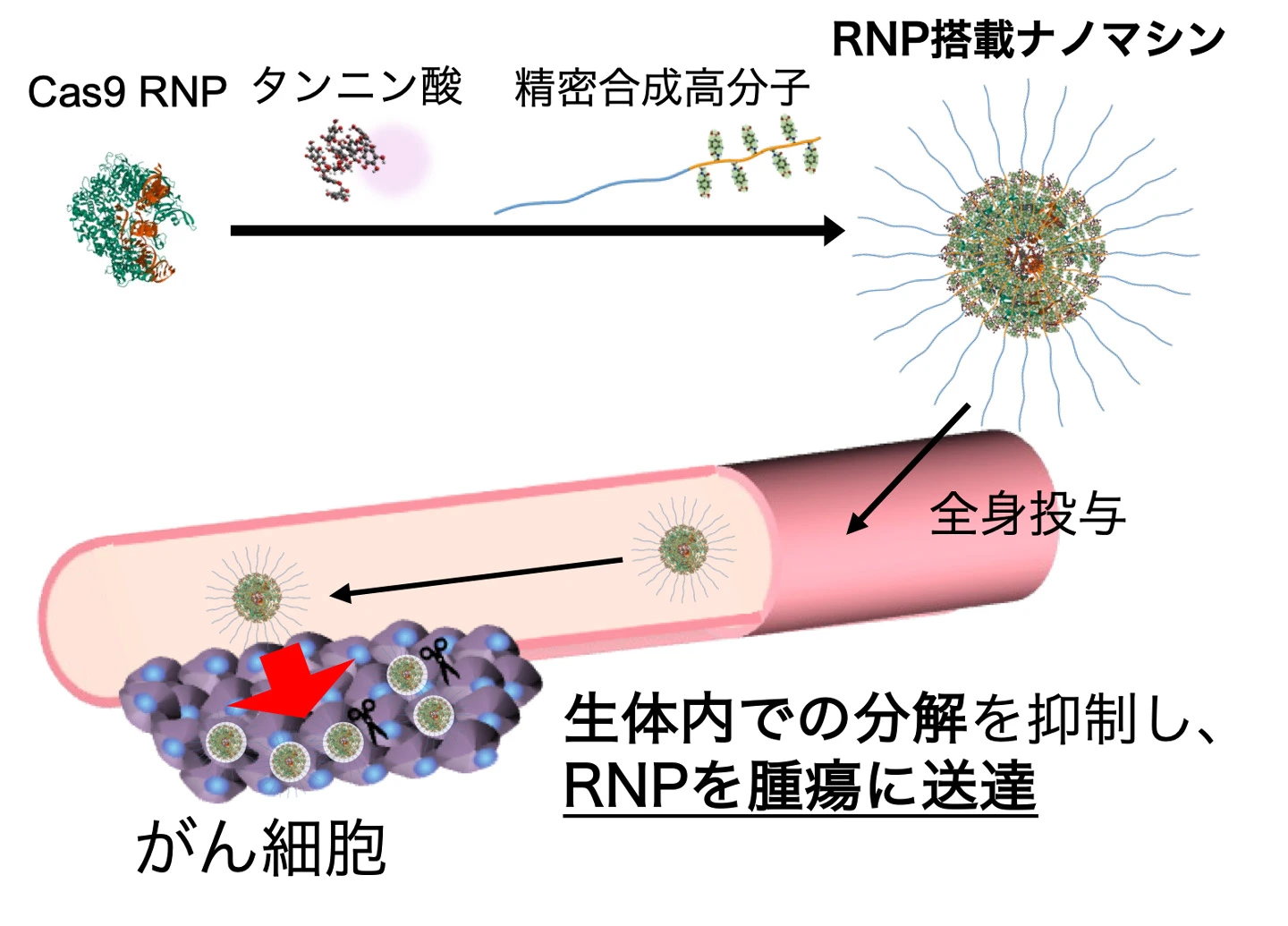
図1. ナノマシンを利用したRNP送達技術の概念図。ポリフェノール(タンニン酸)を活用したナノマシンがRNPをがん細胞内の標的箇所にピンポイントで送達し、がん治療を達成
<関連情報>
- https://www.isct.ac.jp/ja/news/6u1udz48rn73
- https://pubs.acs.org/aamick/article/18/40/54618/5443094/Sequentially-Self-Assembled-Supramolecular
逐次的に自己組織化された超分子ナノ複合体により、全身へのCas9 RNP送達と生体内腫瘍ゲノム編集 が可能になる Sequentially Self-Assembled Supramolecular Nanocomplexes Enable Systemic Cas9 RNP Delivery and In Vivo Tumor Genome Editing
Takumi Matsuo; Yuto Honda; Toshizumi Chino; Takahiro Nomoto; Yuriko Osakabe; Yutaka Miura; Nobuhiro Nishiyama
ACS Applied Materials & Interfaces Published:October 01, 2026
DOI:https://doi.org/10.1021/acsami.6c14858
Abstract
In vivo genome editing utilizing Cas9/sgRNA ribonucleoproteins (RNPs) holds substantial therapeutic promise, yet rapid bloodstream clearance and degradation of RNPs have hindered its accumulation within the target site and effective gene editing. Herein, we report a supramolecular ternary complex platform where RNPs are co-assembled with tannic acid (TA) and phenylboronic acid (PBA)-conjugated polymers through sequential self-assembly. This ∼30 nm core–shell structure protects RNPs from enzymatic degradation and dissociates selectively at endosomal pH. Upon intravenous administration in subcutaneous tumor-bearing mice, the ternary complex exhibits prolonged blood circulation and preferential tumor accumulation, achieving 37.2% gene editing at tumor sites compared with only 1.5% for free RNPs. The platform successfully disrupts PLK1 in subcutaneous tumors, accompanied by significant tumor growth suppression. This is further applied to a KRASG13D-mutant tumor model, in which treatment delayed tumor growth. By integrating sequential supramolecular self-assembly with stimuli-responsive cargo release, this strategy presents a promising approach for systemic RNP delivery and tumor genome editing.