2026-01-25 ユニバーシティ・カレッジ・ロンドン(UCL)
<関連情報>
- https://www.ucl.ac.uk/news/2026/jan/lab-grown-mini-stomachs-could-boost-understanding-rare-diseases
- https://www.nature.com/articles/s41551-025-01553-y
機能的胃壁成熟および前庭部小窩過形成の患者特異的モデリングのためのヒト胃多領域アセンブロイド Human gastric multi-regional assembloids for functional parietal maturation and patient-specific modelling of antral foveolar hyperplasia
Brendan C. Jones,Giada Benedetti,Giuseppe Calà,Ramin Amiri,Lucinda Tullie,Roberto Lutman,Jahangir Sufi,Lucy Holland,Daniyal J. Jafree,Monika Balys,Glenn Anderson,Ian C. Simcock,Owen J. Arthurs,Simon Eaton,Nicola Elvassore,Vivian SW Li,Christopher J. Tape,Kelsey DJ Jones,Camilla Luni,Giovanni Giuseppe Giobbe & Paolo De Coppi
Nature Biomedical Engineering Published:23 January 2026
DOI:https://doi.org/10.1038/s41551-025-01553-y
Abstract
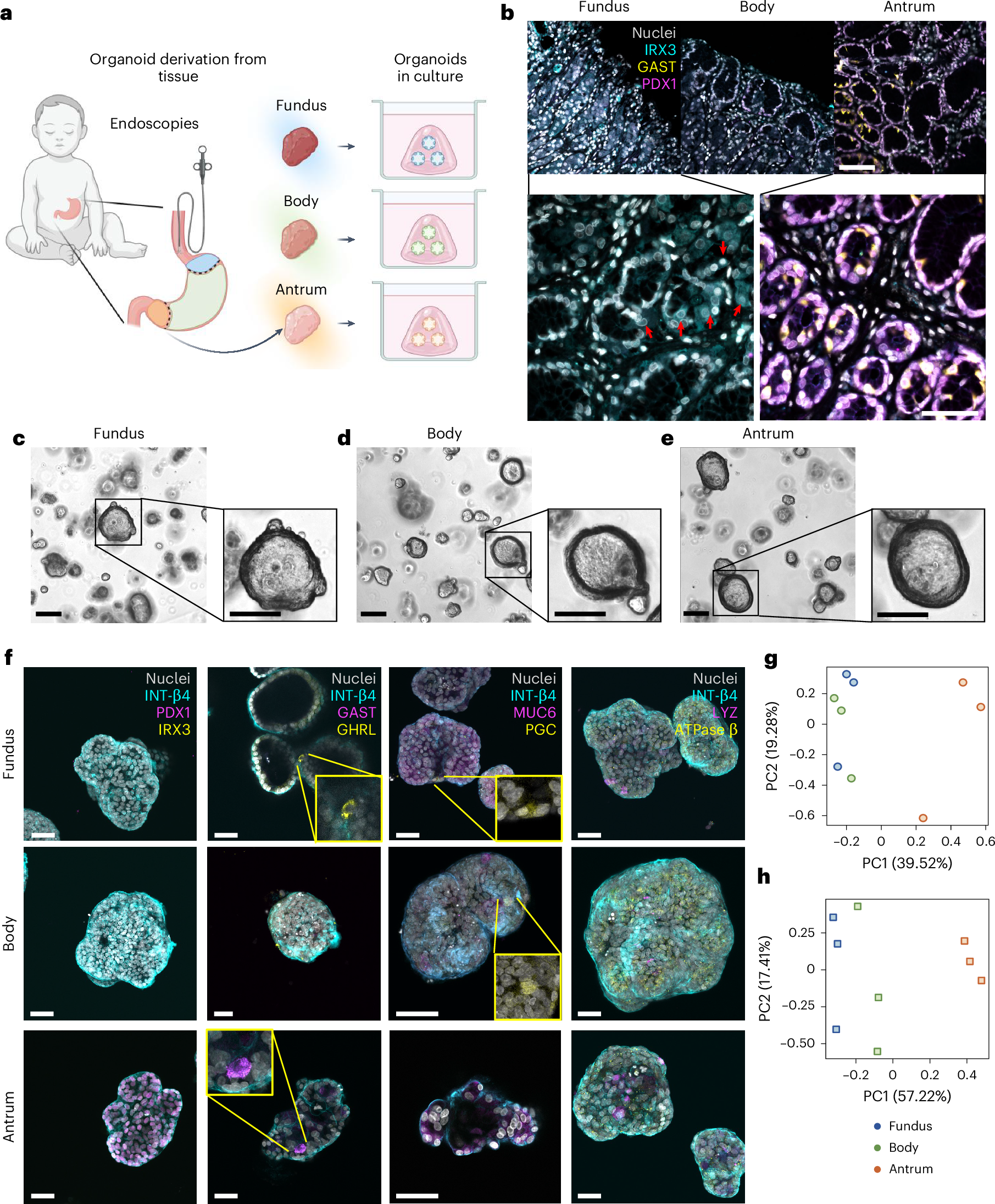
Patient-derived human organoids have the capacity to self-organize into more complex structures. However, to what extent gastric organoids can recapitulate differentiated cell types and mucosal functions remains unexplored. Here we report on how region-specific gastric organoids can self-assemble into complex multi-regional assembloids. These assembloids show increased complexity and cross-communication between different gastric regions, allowing for the emergence of the elusive parietal cell type that is responsible for the production of gastric acid and shows a functional response to drugs targeting the H+/K+ ATPase pump. We generate assembloids from paediatric patients with a genetic condition found to be associated with unusual antral foveolar hyperplasia and hyperplastic polyposis. Our multi-regional assembloid efficiently recapitulates hyperplastic-like antral regions, with decreased mucin secretion and glycosylated H+/K+ ATPase subunit beta, which results in impaired gastric acid secretion. Multi-regional gastric assembloids, generated using paediatric-stem-cell-derived organoids, successfully recapitulate the structural and functional characteristics of the human stomach, offering a promising tool for studying gastric epithelial interactions and disease mechanisms that were previously challenging to investigate in primary models.