2026-07-29 東京大学
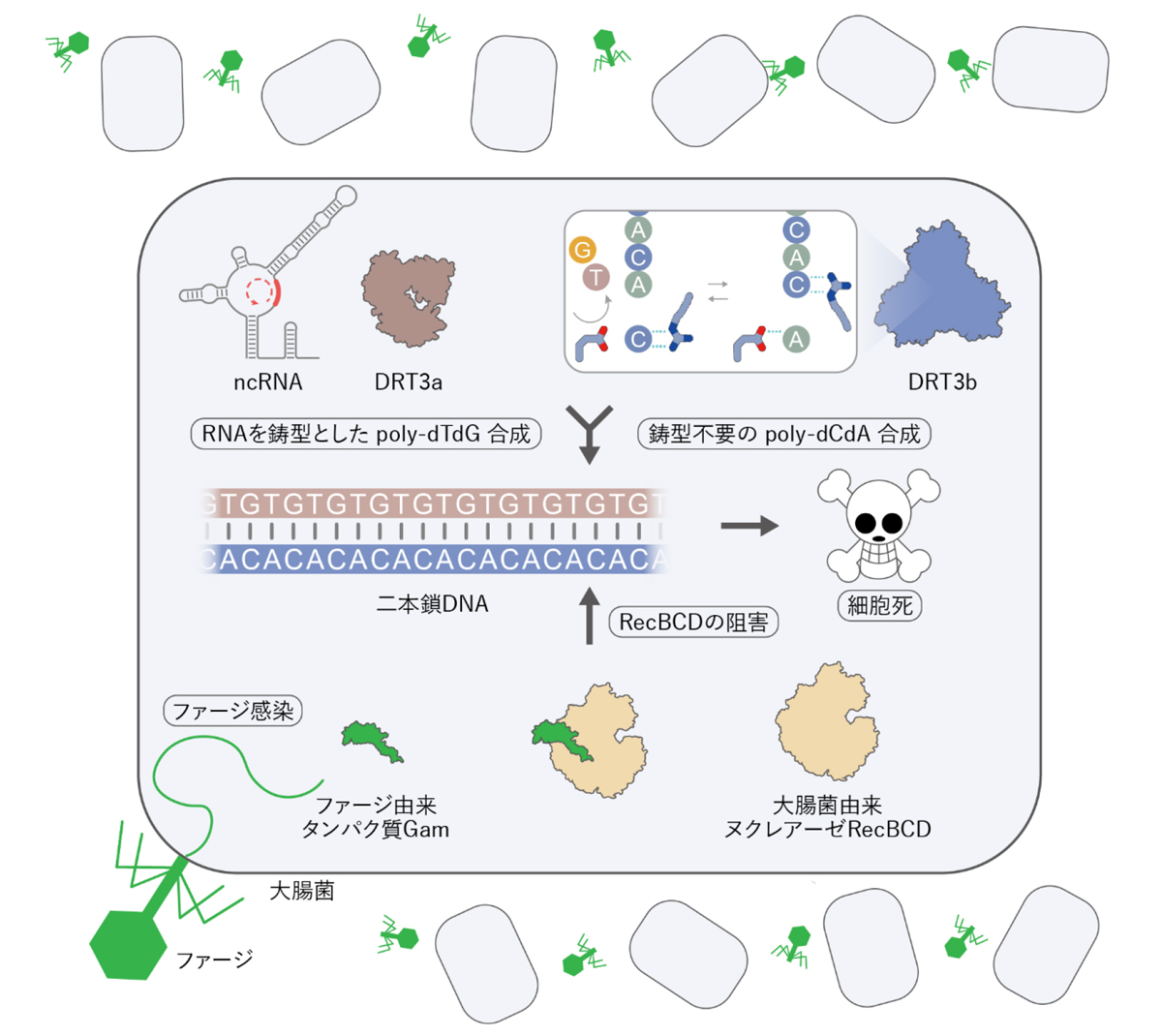
DRT3システムによる抗ファージ防御機構
<関連情報>
- https://www.rcast.u-tokyo.ac.jp/ja/news/release/20260729.html
- https://www.cell.com/cell/abstract/S0092-8674(26)00810-X
二重逆転写酵素免疫システムによるRNAおよびタンパク質を鋳型とした二本鎖DNAの協調合成 Coordinated RNA- and protein-templated synthesis of double-stranded DNA by a dual reverse transcriptase immune system
Megan Wang ∙ Kanta Yoneyama ∙ Rimantė Žedaveinytė ∙ … ∙ Keitaro Yamashita ∙ Hiroshi Nishimasu ∙ Samuel H. Sternberg
Cell Published:July 28, 2026
DOI:https://doi.org/10.1016/j.cell.2026.07.012
Highlights
- DRT3 pairs two reverse transcriptases to make dsDNA for antiphage defense
- DRT3a is RNA-templated, and DRT3b synthesizes DNA from a protein template
- Cryo-EM shows that DRT3b uses E22 and R241 as the template for alternating dC/dA
- λ phage Gam, a RecBCD inhibitor, triggers DRT3 abortive infection
Summary
Defense-associated reverse transcriptase (DRT) systems mediate antiviral immunity through distinct modes of cDNA synthesis: class 1 DRTs catalyze untemplated synthesis, whereas class 2 DRTs polymerize non-coding RNA-templated products. However, how these distinct modes drive defense remains unclear. Here, we report that DRT3 immunity arises when class 1 and class 2 RT activities cooperate to produce self-complementary double-stranded DNA (dsDNA). DRT3a uses a 5′-ACACAC-3′ RNA template to synthesize poly-(dTdG) repeats, whereas DRT3b synthesizes poly-(dCdA) repeats without any nucleic acid template. Cryo-electron microscopy reveals that DRT3b forms a hexamer and uses active-site-adjacent residues as deoxyadenosine and deoxycytidine gates to enforce alternating nucleotide addition, representing a unique example of amino-acid-templated DNA polymerization. DRT3 is toxic in cells lacking RecBCD, implicating host recombination machinery in limiting dsDNA accumulation, and the phage-encoded RecBCD inhibitor Gam triggers DRT3-mediated abortive infection. These findings reveal how two polymerases with distinct templating strategies generate complementary DNA for antiviral defense.