2026-09-28 東京大学
成人発症non-5q SMAでLRP12遺伝子のCGGリピート伸長を同定
<関連情報>
- https://www.h.u-tokyo.ac.jp/press/20260928.html
- https://www.h.u-tokyo.ac.jp/press/__icsFiles/afieldfile/2026/09/29/release_20260928.pdf
- https://www.neurology.org/doi/10.1212/NXG.0000000000200440
成人発症型非5q脊髄性筋萎縮症患者におけるLRP12 CGGリピート伸長 LRP12 CGG Repeat Expansions in Patients With Adult-Onset Non-5q Spinal Muscular Atrophy
Hiroya Naruse Jun Mitsui, Hiroyuki Ishiura, So Okubo, Chiharu Yoshida, Akihiko Mitsutake, Kyoko Maruta, … Show All … , and Tatsushi Toda
Neurology Genetics Published:September 23, 2026
DOI:https://doi.org/10.1212/NXG.0000000000200440
Abstract
Background and Objectives
Non-5q spinal muscular atrophy (SMA) is genetically heterogeneous, yet many adult-onset cases remain molecularly undiagnosed. CGG repeat expansions in the 5′ untranslated region of LRP12, originally identified in oculopharyngodistal myopathy, have also been implicated in amyotrophic lateral sclerosis (ALS) and inherited peripheral neuropathy. The aim of this study was to determine whether LRP12 CGG repeat expansions occur in patients with adult-onset proximal-predominant non-5q SMA and characterize the associated clinical presentations.
Methods
In this observational case series, we enrolled 8 consecutive, genetically unresolved families that met prespecified criteria for adult-onset non-5q SMA after exclusion of known genetic causes of SMA and familial ALS by comprehensive genetic evaluation, including whole-exome sequencing. LRP12 CGG repeat expansions were screened by repeat-primed PCR and then confirmed and sized by Oxford Nanopore long-read sequencing. LRP12 CGG repeat expansions were also screened in 496 unrelated ALS cases and 1,000 controls.
Results
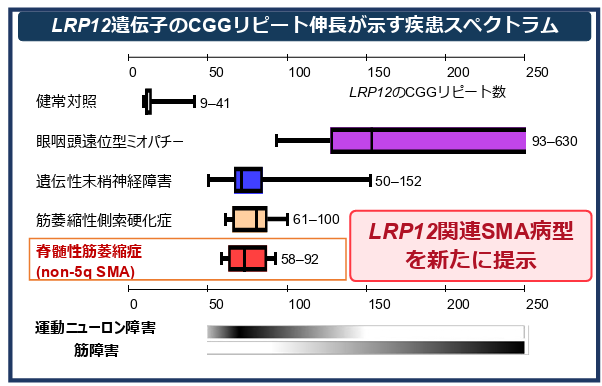
Monoallelic LRP12 CGG repeat expansions were identified in 6 of the 8 non-5q SMA probands (75%). Five of the 6 positive families were consistent with autosomal-dominant inheritance. Expanded alleles ranged from 58 to 92 repeat units. Affected individuals showed adult-onset, slowly progressive, proximal-predominant pure lower motor neuron weakness with preserved bulbar and sensory function and no upper motor neuron signs. Expansions were rare in ALS cases (2/496, 0.40%) and controls (2/1,000, 0.20%).
Discussion
We identified LRP12 CGG repeat expansions in a substantial proportion of patients with slowly progressive, proximal-predominant pure lower motor neuron weakness not linked to 5q-SMA. These findings broaden the clinical spectrum of LRP12-related disease and support inclusion of LRP12 repeat-expansion analysis in the evaluation of genetically unresolved adult-onset lower motor neuron syndromes.