2026-09-29 東京科学大学
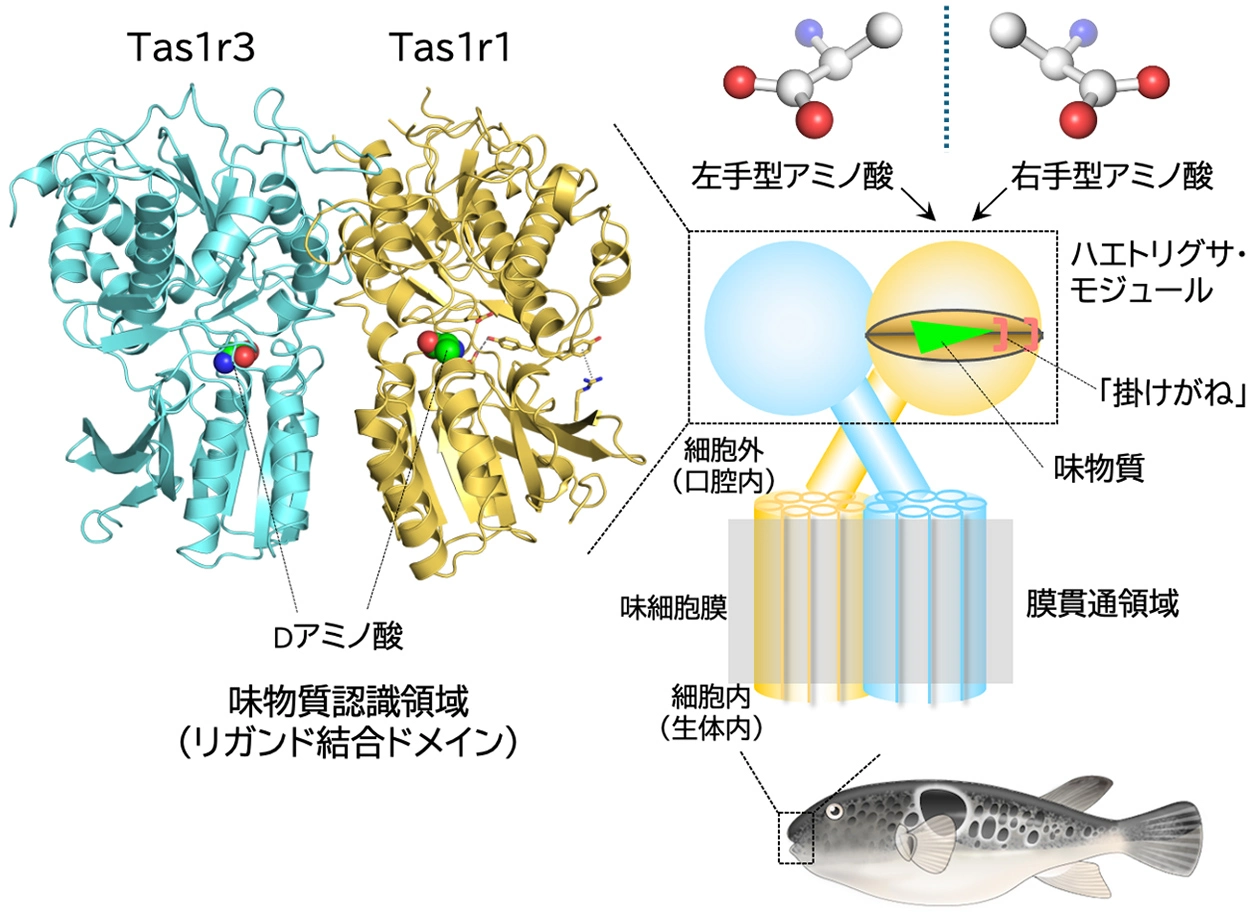
図1. フグ味覚受容体の模式図と味物質認識領域の構造
<関連情報>
味覚受容体における立体化学的多様性の同定と構造的特徴付け Identification and structural characterization of stereochemical promiscuity in a taste receptor
Rakuto Mizoguchi, Yasuka Toda https://orcid.org/0000-0001-5912-6730, Mana Nagae, +13 , and Atsuko Yamashita
Proceedings of the National Academy of Sciences Published:September 15, 2026
DOI:https://doi.org/10.1073/pnas.2534924123
Abstract
Taste receptor type 1 (TAS1R), which consists of sweet and umami receptors in humans, senses nutrients (such as sugars and amino acids) with substrate specificity that is often broad and varies among animals and subtypes. However, the structural basis for achieving diverse specificities remains largely elusive. Here, we present the crystal structure of the ligand-binding domain (LBD) of Tas1r1/Tas1r3 heterodimer from pufferfish, an ortholog of the human umami taste receptor. The overall structure of Tas1r1/Tas1r3LBD resembles previously reported TAS1R structures, indicating a conserved core architecture within the family. Nevertheless, pufferfish Tas1r1/Tas1r3 was found to bind and respond to both l- and d-amino acids, even though TAS1Rs are considered to respond to either enantiomer. Structural and mutational analyses revealed that this nonrigorous stereochemical recognition is attributed to intersubdomain interactions that latch the cleft containing the amino acid-binding site. These interactions prevent the cleft from fully opening, thereby stabilizing the active conformation, even if the ligand has a different chirality. These results suggest that different substrate specificities in TAS1Rs can be acquired not only by the gain or loss of direct interactions with the substrate but also by the gain of intramolecular interactions, which alter the conformational equilibrium of the receptor.