2026-09-18 スタンフォード大学
<関連情報>
- https://news.stanford.edu/stories/2026/09/human-brain-two-separate-organs
- https://www.nature.com/articles/s41593-026-02433-7
2つの並行する神経外胚葉前駆細胞が発達中の脳に寄与する Two parallel neural ectoderm progenitors contribute to the developing brain
Rayyan T. Jokhai, Carolyn E. Dundes, Hadia S. Ahsan, Rachel S. Kang, Rachel E. A. Salomon-Shulman, Arjun Rajan, Yoon Seok Kim, Liam J. Stanton, Christine Xu, Stephanie Do, Brennan D. McDonald, José Miguel Andrade López, Hugo A. Urrutia, Hannah Greenfeld, Alicia Wong, Yimiao Qu, Andrew S. Petkovic, Yi Miao, K. Christopher Garcia, Michelle Monje, Daniel E. Wagner, Marianne E. Bronner, Christopher J. Lowe & Kyle M. Loh
Nature Neuroscience Published:18 September 2026
DOI:https://doi.org/10.1038/s41593-026-02433-7
Abstract
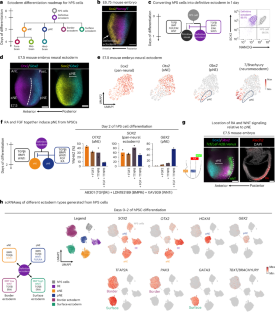
When and how different brain regions diversify from one another remains unresolved. Does a common neural ectoderm progenitor generate the entire brain? Or do multiple neural ectoderm progenitors exist, each restricted to form specific brain regions? Here our lineage tracing studies of mouse embryos support the latter model. Two parallel brain progenitors emerge simultaneously during gastrulation: anterior neural ectoderm (forebrain/midbrain progenitor) and posterior neural ectoderm (hindbrain progenitor). Differentiation of human pluripotent stem cells into anterior or posterior neural ectoderm-like cells revealed these were lineage committed to forebrain/midbrain versus hindbrain fates, respectively. They harbored diverging chromatin landscapes foreshadowing future forebrain/midbrain versus hindbrain identities. We further differentiated human pluripotent stem cells into hindbrain rhombomere 5/6-specific motor neurons, which were hitherto difficult to generate in vitro. Hence, we postulate the brain is a composite organ emanating from two lineage-restricted progenitors; these dual progenitors may be evolutionarily conserved across 550 million years from hemichordates to mammals.