2026-10-09 京都大学iPS細胞研究所
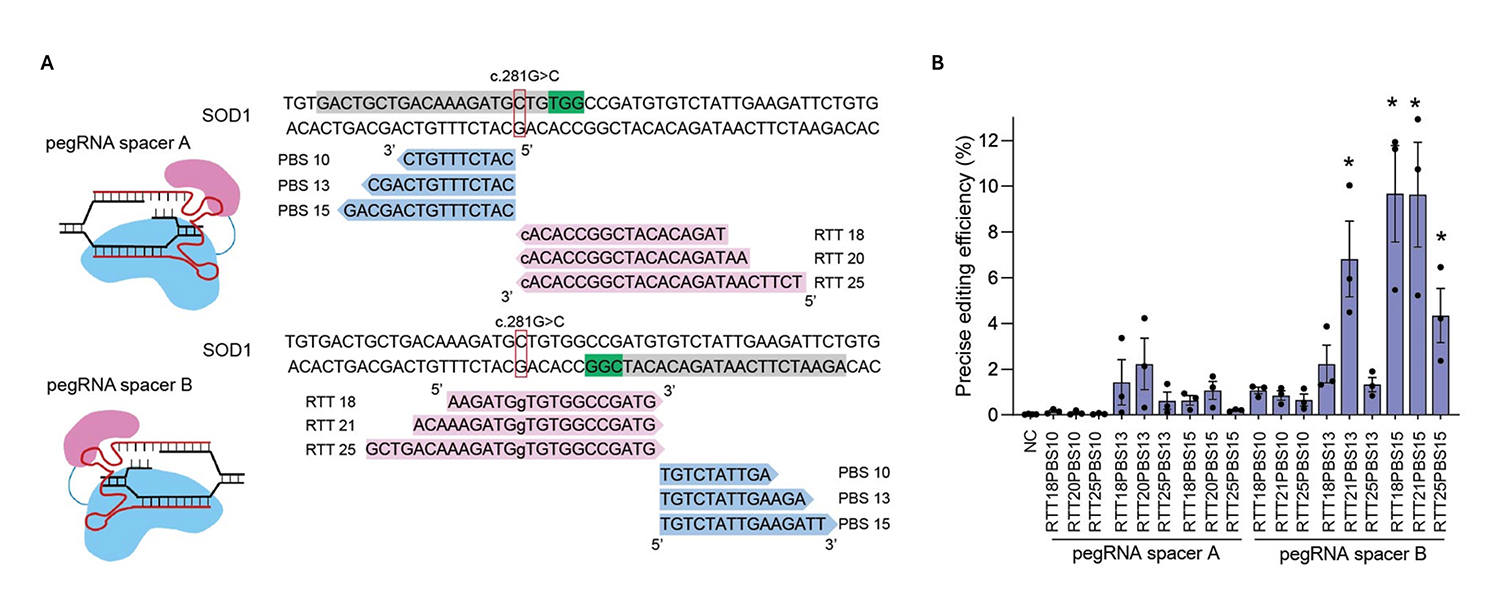
図1 プライム編集によりSOD1遺伝子のG93A変異を修正
A:プライム編集を行うための配列候補。
B:遺伝子編集効率のスクリーニング結果。複数のpegRNA設計を比較し、最適な条件で約10%の修正効率を得た。
<関連情報>
- https://www.cira.kyoto-u.ac.jp/j/pressrelease/news/261009-100000.html
- https://link.springer.com/article/10.1186/s12920-026-02492-6
ヒト誘導多能性幹細胞におけるプライムおよびベース編集を用いた家族性ALSにおけるSOD1の変異特異的修復 Mutation-specific correction of SOD1 in familial ALS using prime and base editing in human induced pluripotent stem cells
Keiko Imamura, Kayoko Tsukita, Shin Yoshioka, Aya Okusa, Hitoshi Mitsunobu, Knut Woltjen, Keiji Nishida, Yuishin Izumi & Haruhisa Inoue
B<C Medical Genomics Published:30 September 2026
DOI:https://doi.org/10.1186/s12920-026-02492-6 Early provide
Abstract
Background
Amyotrophic lateral sclerosis (ALS) is a fatal neurodegenerative disorder characterized by progressive motor neuron degeneration and respiratory failure. Approximately 10% of ALS cases are familial, with mutations in SOD1 representing a major genetic cause. Preservation of physiological SOD1 function may be important, suggesting that mutation-specific gene correction could serve as a complementary therapeutic strategy.
Methods
We sought to establish optimized genome editing configurations for therapeutic correction of two clinically relevant SOD1 mutations: G93A, a widely used mutation in animal models, and L126S, a mutation enriched in Japanese patients. Induced pluripotent stem cells (iPSCs), including patient-derived lines, were employed as disease-relevant human cellular platforms to enable systematic screening and comparative evaluation of genome editing strategies within defined genetic backgrounds. For the G93A mutation, a prime editing approach was implemented, and pegRNA screening was conducted in human iPSCs harboring the mutation, followed by evaluation in mouse iPSCs derived from ALS model mice. For the L126S mutation, three cytosine base editors—BE4, YE1, and AID2S—were screened in combination with guide RNAs in patient-derived iPSCs.
Results
For the G93A mutation, prime editing was performed, and pegRNA screening identified an optimized configuration that achieved approximately 10% precise correction efficiency, with similar editing rates observed in both human and mouse iPSCs. For the L126S mutation, screening of base editors and guide RNAs demonstrated that BE4 achieved the highest correction efficiency, reaching approximately 25% in patient-derived iPSCs, outperforming YE1 and AID2S.
Conclusions
These findings demonstrate the feasibility of mutation-specific genome correction in human disease-relevant cellular models and highlight the potential of iPSC-based platforms for the preclinical development of mutation-corrective gene therapy for SOD1-associated familial ALS.