2026-09-15 東京大学,科学技術振興機構
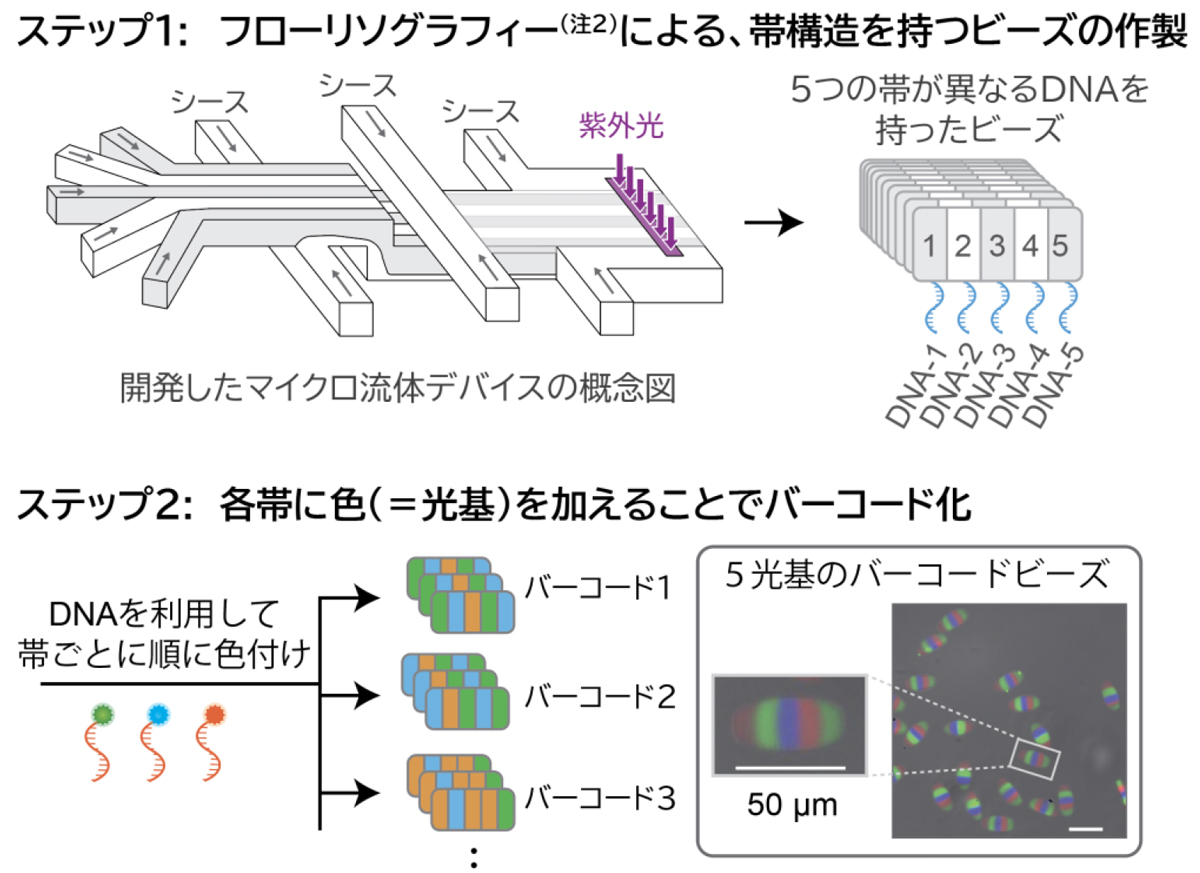
本研究で開発したバーコード作製技術
<関連情報>
- https://www.rcast.u-tokyo.ac.jp/ja/news/release/20260915_1.html
- https://advanced.onlinelibrary.wiley.com/doi/10.1002/advs.77407
製造工程と符号化工程の分離:大規模なユーザー定義型光学バーコードライブラリのためのDNAアドレス指定可能なテンプレート微粒子 Decoupling Fabrication From Encoding: DNA-Addressable Template Microparticles for Large, User-Defined Optical Barcode Libraries
Akihiro Eguchi, Yuichiro Iwamoto, Hinata Tokuda, Haruka Narita, Adrian M. Martin, Sadao Ota
Advanced Science Published: 14 September 2026
DOI:https://doi.org/10.1002/advs.77407
ABSTRACT
Optical barcodes for pooled high-throughput screening must support large libraries while remaining decodable in a single imaging step. Existing approaches often trade design control for manufacturability: deterministic barcodes often require per-code redesign of particle fabrication, whereas stochastic combinatorial barcodes are difficult to generate as predefined batches. Here we introduce a chemically programmable barcoding architecture that decouples particle fabrication from barcode assignment. Using a contact-free multilaminar flow lithography platform with all-around three-dimensional sheathing, we continuously fabricate a universal hydrogel scaffold containing five spatially segregated DNA-addressable domains at rates > 106 particles/h. Chosen barcode identities are subsequently written on demand onto the same template batch by domain-selective DNA hybridization. Single-domain measurements resolved 64 candidate optical states, indicating an experimentally informed theoretical upper bound of 645 ≈ 1.1 × 10⁹ barcodes. We further implemented a predefined 59,049-code library by split-pool labeling, achieving an 83.6% recovery of decoded beads at a stringent posterior threshold (≥ 0.95). After 11 days, >7,800 beads were correctly re-identified at ≥ 0.95 accuracy in matched fields of view. This strategy provides a highly scalable, chemically programmable route to build large, user-defined optical barcode libraries with single-image optical readout and longitudinal traceability.