2026-09-14 シンガポール国立大学(NUS)
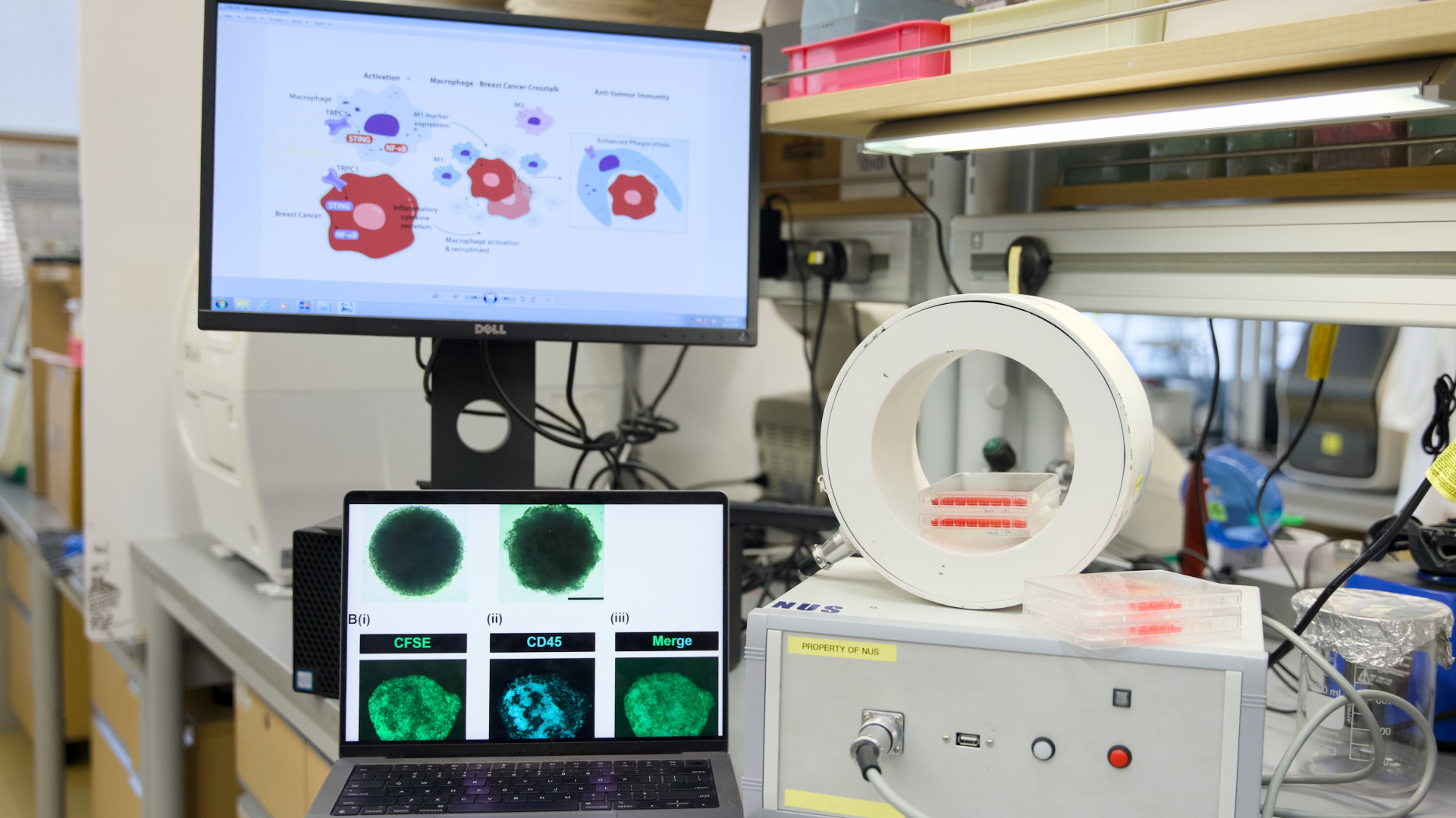
The NUS team used the PEMF device (right) to completely eliminate breast cancer tumours in 75 per cent of tested preclinical models after only four 30-minute sessions. Since chemotherapy is not used, its associated side effects are avoided.
<関連情報>
- https://news.nus.edu.sg/magnetic-pulses-reprogram-immune-cells-to-fight-breast-cancer/
- https://onlinelibrary.wiley.com/doi/10.1002/smmd.70038
マクロファージの磁気再プログラミングは、TRPC1-STING炎症経路を介して乳がん細胞の貪食を促進する Magnetic Reprogramming of Macrophages Stimulates Phagocytosis of Breast Cancer Cells via a TRPC1-STING Inflammatory Axis
Viresh Krishnan Sukumar, Yee Kit Tai, Jan Nikolas Iversen, Olivia Yeo, Anisha Praiselin Paul, Kwan Yu Wu, Lina Hsiu Kim Lim, Alfredo Franco-Obregón
Smart Medicine Published: 04 June 2026
DOI:https://doi.org/10.1002/smmd.70038
ABSTRACT
The reprogramming of tumor-associated macrophages (TAMs) from a pro-tumoral M2 to an anti-tumoral M1 phenotype is an attractive therapeutic strategy whose clinical translation is undermined by the systemic toxicity of currently available pharmacological approaches. Here, we demonstrate that non-invasive and localizable pulsed electromagnetic fields (PEMFs) induce macrophage reprogramming downstream of transient receptor potential canonical 1 (TRPC1) channel activation. Brief (10 min) PEMF exposure polarized macrophages toward an M1 phenotype by activating Stimulator of Interferon Genes (STING)-dependent NF-κB inflammatory pathways that were abolished by TRPC1 knockdown or inhibition. PEMF exposure directly enhanced the immunogenicity of breast cancer cells and modified macrophage-cancer crosstalk to promote M1 macrophage polarization and the attraction of STING-activated macrophages to the cancer cells. In co-cultures, PEMF exposure stimulated macrophage-mediated phagocytosis of cancer cells in a STING- and TRPC1-dependent manner. In spheroids, PEMFs induced the reprogramming of TAMs to an M1 status and selectively enhanced infiltration of M1 macrophages, resulting in STING-mediated phagocytosis of cancer cells. In mice, 2 weeks of twice-weekly PEMF exposure resorbed engrafted tumors and selectively eliminated cancer cells within tumors while promoting immune cell recruitment. PEMFs offer a non-invasive manner to locally reprogram TAMs within the tumor microenvironment to preferentially eliminate cancer cells.
Highlights
- PEMFs reprogram macrophages toward the M1 state.
- PEMFs activate the STING pathway in a TRPC1-dependent manner.
- PEMFs enhance cancer immunogenicity.
- PEMFs modulate macrophage-cancer cell paracrine crosstalk.
- PEMFs enhance anti-cancer immunity by promoting macrophage-mediated cancer-specific phagocytosis in vitro, ex vivo and in vivo.