2026-10-05 名古屋大学
<関連情報>
- https://www.nagoya-u.ac.jp/researchinfo/result/2026/10/-gpcr.html
- https://www.cell.com/cell-chemical-biology/abstract/S2451-9456(26)00336-3
ESCAPEは、GPCRシグナル伝達の受容体特異的な化学遺伝学的解析を可能にする ESCAPE enables receptor-specific chemogenetic dissection of GPCR signaling
Yuma Matsuoka ∙ Hajime Inoue ∙ Tatsuki Hori, ∙ … ∙ Satoru Takahashi ∙ Tomohiro Doura ∙ Shigeki Kiyonaka
Cell Chemical Biology Published:October 2, 2026
DOI:https://doi.org/10.1016/j.chembiol.2026.09.008
Highlights
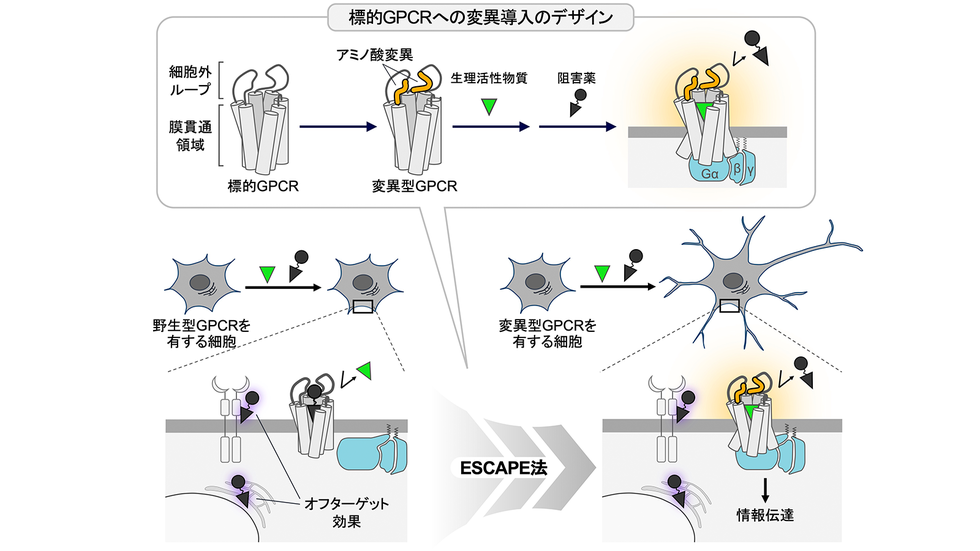
- ESCAPE enables off-target-free chemogenetic interrogation of GPCR function
- ESCAPE-A2AR reveals A2AR-dependent hypoxia-induced neurite outgrowth
- ESCAPE generalizes across class A GPCRs, including 5-HT2AR
- ESCAPE interrogates endogenous GPCRs at physiological expression levels
Summary
G-protein-coupled receptors (GPCRs) are essential mediators of cellular processes, and their dysfunction is implicated in various diseases. Although pharmacological approaches are powerful for elucidating GPCR functions, careful consideration of potential off-target effects remains crucial. Here, we present an off-target-free chemogenetic platform to dissect the physiological roles of target GPCRs. As a proof-of-concept, we focused on the adenosine A2A receptor (A2AR), a prototypical GPCR involved in neurodegenerative diseases. Leveraging the ligand recognition mechanisms of A2AR, we designed a prominent chemogenetic pair comprising a clinically validated A2AR antagonist and an engineered A2AR mutant that is insensitive to the antagonist but retains responsiveness to adenosine. Using this pair, we uncovered the critical role of A2AR in neurite outgrowth under hypoxic conditions in neuron-like cells, while avoiding potential off-target effects. Furthermore, we demonstrate the generalizability of this chemogenetic approach to other class A GPCRs, offering a versatile platform for receptor-specific dissection of GPCR signaling.