2026-08-19 北海道大学
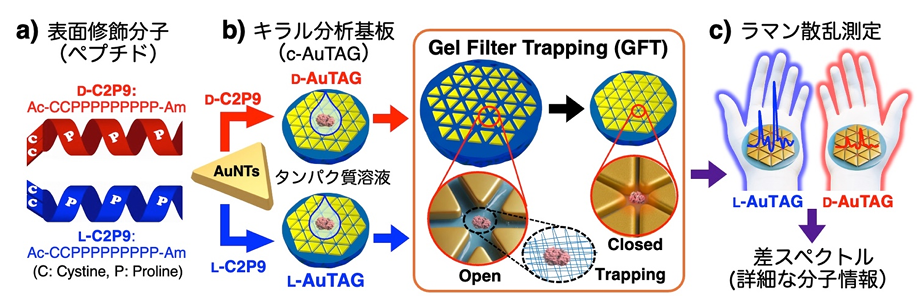
図1.(a)表⾯修飾に⽤いたL体・D体のペプチド。(b)ペプチドで修飾した三⾓形プレート状⾦ナノ粒⼦⾃⼰組織化膜をハイドロゲル上へ転写して作製したキラル分析基板(c-AuTAG)とGel Filter Trapping 法によるタンパク質の導⼊。(c)ラマン分光装置を⽤いたラマン散乱測定と差スペクトル解析によるタンパク質の⽴体構造を反映した分⼦構造情報の取得のイメージ図。
<関連情報>
- https://www.hokudai.ac.jp/news/2026/08/post-2417.html
- https://www.hokudai.ac.jp/news/pdf/260819_pr3.pdf
- https://pubs.acs.org/ascefj/article/doi/10.1021/acssensors.6c03237/5259475/Peptide-Induced-Chiral-Plasmonic-Hotspots-for
ペプチド誘起キラルプラズモニックホットスポットを用いたタンパク質の超高感度キラリティ依存ラマン分析Peptide-Induced Chiral Plasmonic Hotspots for Ultrasensitive Chirality-Dependent Raman Analysis of Proteins
Md Abdul Kaiyum;Tianxu Gao;Han Lin;Xu Shi;Keiji Sasaki;Hiroaki Misawa;Kuniharu Ijiro;Hideyuki Mitomo
ACS Sensors Published:August 16, 2026
DOI:https://doi.org/10.1021/acssensors.6c03237
Abstract
Highly sensitive chirality-dependent Raman analysis capable of probing protein structural information is important for bioanalytical applications. Although chiral plasmonic nanostructures can generate chirality-dependent electromagnetic fields, efficient localization of proteins within these hotspots under hydrated conditions remains challenging, limiting their application to chirality-dependent Raman analysis. Here, peptide-induced chiral plasmonic hotspots are introduced in gold nanotriangle–hydrogel platforms (c-AuTAG) for ultrasensitive chirality-dependent Raman analysis of proteins. Enantiomeric oligo-proline peptides introduce well-defined chirality into plasmonic nanogaps while minimizing protein adsorption and charge-dependent interactions that would otherwise hinder efficient analyte localization within plasmonic hotspots. The peptide-induced chiral hotspots are integrated with the previously developed GFT delivery strategy. Efficient analyte delivery through antifouling interfaces enables protein accumulation within dynamically tunable plasmonic hotspots. The system exhibits exceptionally large SERS chiral anisotropy factors (gSERS-ChA > 1.8) despite a small far-field optical dissymmetry factor (goptical ≈ 0.001), consistent with strong chirality-dependent plasmonic enhancement. The observed response reflects interactions between localized plasmonic near fields and vibrational-mode-dependent molecular polarizability. Ultrasensitive detection down to fg/mL is achieved within seconds using a conventional Raman spectrometer with linearly polarized excitation, enabling differential vibrational spectral analyses analogous to those used in Raman optical activity (ROA) without circular polarization optics. This platform enables ultrasensitive chirality-dependent Raman analysis of biomolecules in hydrated environments while preserving native structures, providing a practical approach for probing protein secondary structures, conformational changes, and biologically relevant molecular modifications.