2026-06-16 水産研究・教育機構,東京大学大気海洋研究所,北海道大学,長野県諏訪湖環境研究センター,Eastern Michigan University
<関連情報>
- https://www.fra.go.jp/home/kenkyushokai/press/pr2026/20260616_press_oshorokoma.html
- https://www.fra.go.jp/home/kenkyushokai/press/pr2026/files/20260616_press_oshorokoma.pdf
- https://academic.oup.com/biolinnean/article-abstract/148/1/blag026/8697451
異所的生息地における 2種のサケ科魚類、 Salvelinus curilusとS. leucomaenis の浸透性雑種の起源と存続を追跡する Tracing the origin and persistence of introgressive hybrids of two salmonid species, Salvelinus curilus and S. leucomaenis, in allopatric habitats
Shoichiro Yamamoto,Shujuan Xia,Kousei Fukuzawa,Kentaro Morita,Satoshi Kitano,Masashi Sekino,Yoshiyuki Umatani,Uli Reinhardt,Koji Maekawa
Biological Journal of the Linnean Society Published:28 May 2026
DOI:https://doi.org/10.1093/biolinnean/blag026
Abstract
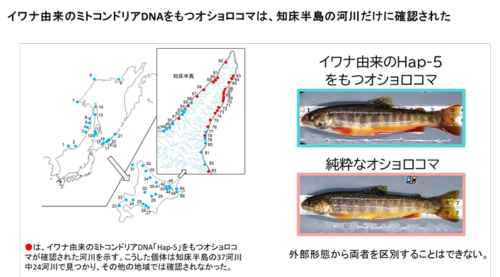
Unravelling the origin and mechanisms of interspecific hybridization and clarifying its evolutionary and ecological consequences constitutes a central theme in evolutionary biology. This study elucidates the origin and mechanisms underlying the persistence of individuals carrying introgressed alleles resulting from historical hybridization between two closely related salmonid species, Salvelinus curilus and S. leucomaenis, in a region where the donor species is now absent. We employed two complementary approaches. First, we conducted a comprehensive comparative phylogeographical analysis across the full geographical ranges of both species to characterize spatial patterns of historical hybridization and infer the origin of introgressed individuals. Second, we developed and applied evolutionary models based on the Wright–Fisher model to evaluate whether the persistence of these individuals is explained by the combined effects of genetic drift and natural selection. Introgressed individuals carried a single mitochondrial DNA haplotype substantially divergent from the recipient species (S. curilus) and matching a haplotype of the donor species (S. leucomaenis) that occurs in areas geographically distant from the current distribution of introgressed individuals. Simulation-based analyses indicated that the observed frequencies of introgressed individuals can be explained largely by genetic drift. Although a model incorporating both genetic drift and selection provided a modestly better fit to the data, support for selection was suggestive rather than conclusive. Even under a weak selective disadvantage, the stochastic effects of genetic drift may allow these individuals to persist over multiple generations, particularly in small populations.