2026-06-17 中国科学院(CAS)
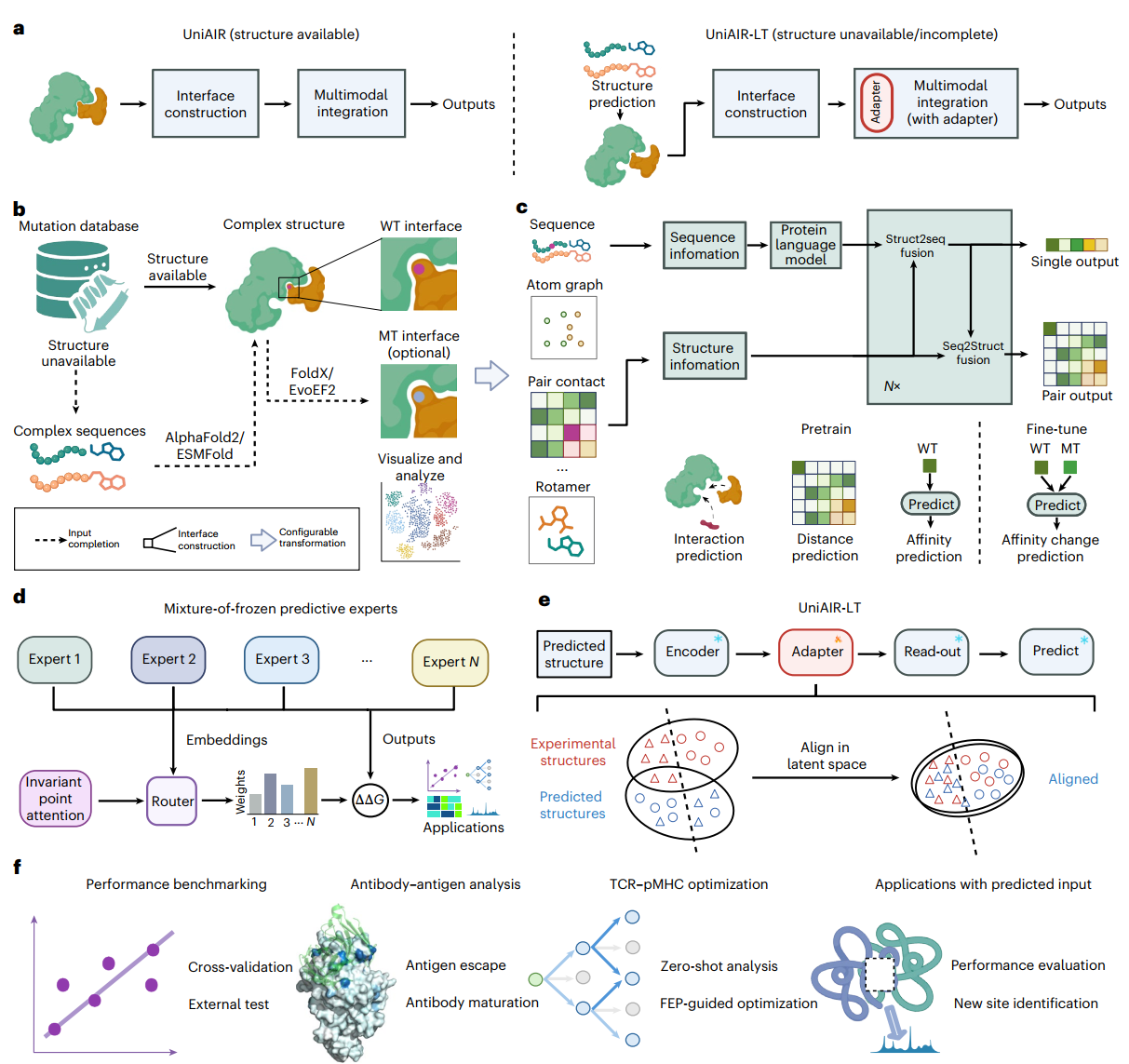
Figure 2. The overall framework of UniAIR (a–e) and its applications (f)
<関連情報>
- https://www.tsinghua.edu.cn/en/info/1245/14952.htm
- https://www.nature.com/articles/s42256-026-01243-7
統一されたマルチモーダルフレームワークによる適応免疫認識全体にわたる一般化可能な変異効果予測 Generalizable mutation-effect prediction across adaptive immune recognition via unified multimodal framework
Rong Han,Yumeng Zhang,Xiaohong Liu,Lei Fu,Tong Pan,Jing Xu,Xiaoyu Wang,Peidong Zhang,Xuanzhong Chen,Jiesi Lei,Wuyang Lan,Changwei Ji,Shuguang Cui,Song Wu,Jiangning Song,Ting Chen & Guangyu Wang
Nature Machine Intelligence Published:27 May 2026
DOI:https://doi.org/10.1038/s42256-026-01243-7
Abstract
Adaptive immunity is a central defence system essential for long-term and highly specific protection against pathogens through the precise molecular recognition of antigens by lymphocytes. However, predicting how mutations reshape these interactions remains a major challenge. Although previous computational approaches leverage large-scale pretraining for mutation-effect predictions, most are designed for specific tasks or modalities and struggle to generalize across the heterogeneous, multimodal landscape of immune recognition. Here we introduce UniAIR, a modular, multimodal framework for the accurate and generalizable prediction of mutation effects across immune recognition scenarios. UniAIR integrates a standardized data pipeline, an interface-centric sequence–structure fusion transformer that integrates evolutionary information with geometric representations, and a suite of extensions for multiexpert consensus and adaptation to predicted structure inputs. We comprehensively evaluated UniAIR through large-scale benchmarking and independent tests across immunological tasks. The evaluation covered both extracellular and intracellular immune recognition, including antibody maturation, antigen escape, TCR–pHLA optimization and analyses in which experimental structures were unavailable. Extensive experiments show that UniAIR achieves state-of-the-art performance and delivers robust predictions with minimal task-specific tuning. In particular, UniAIR successfully performed multiround peptide optimization of a TCR–pHLA complex under sparse feedback and identified key functional mutations in incomplete antibody–antigen structures. Together, UniAIR establishes a unified computational foundation for mapping mutation landscapes, advancing understanding of adaptive immune recognition and accelerating immunotherapeutic design.