2026-08-17 ワシントン大学セントルイス校
that-shuts-off-chronic-pain/
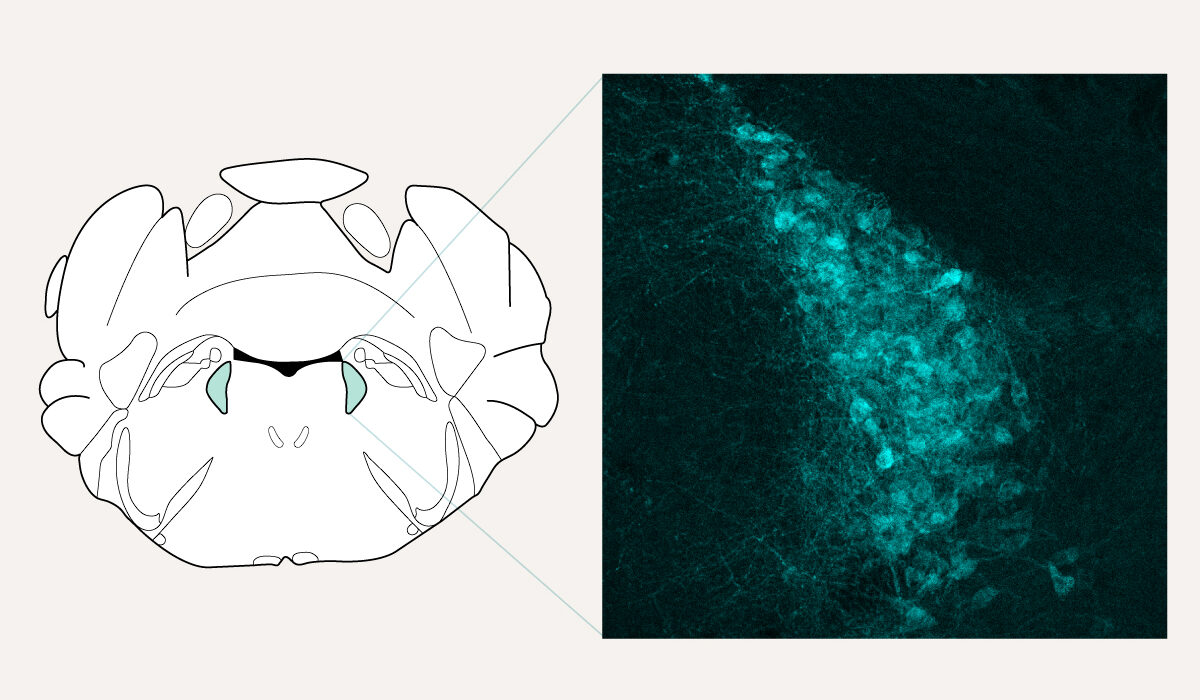
A cluster of nerve cells (cyan, right) in the mouse brain (cyan, left) play a role in both pain relief and the generation of chronic pain. WashU Medicine researchers found that certain receptors on the surface of these cells can shut off chronic pain. (Image: Chao-Cheng Kuo/WashU Medicine)
<関連情報>
- https://source.washu.edu/2026/08/scientists-identify-brains-brake-that-shuts-off-chronic-pain/
- https://www.cell.com/current-biology/fulltext/S0960-9822(26)00947-4
μオピオイド受容体は青斑核の疼痛発生器を制御する Mu opioid receptors gate the locus coeruleus pain generator
Chao-Cheng Kuo ∙ Makenzie R. Norris ∙ Samantha S. Dunn ∙ … ∙ John T. O’Brien ∙ Kyle E. Parker ∙ Jordan G. McCall
Current Biology Published: August 17, 2026
DOI:https://doi.org/10.1016/j.cub.2026.07.048
Highlights
- Locus coeruleus (LC) inhibition drives mechanical and thermal antinociception
- LC differentially modulates hyperalgesia depending on neuropathic injury duration
- Projection-selective LC mu opioid receptors bidirectionally regulate nociception
- LC mu opioid receptor rescue reverses neuropathic injury-induced hyperalgesia
Summary
The locus coeruleus (LC) plays a paradoxical role in chronic pain. Although known as a potent source of endogenous analgesia, increasing evidence suggests injury transforms the LC into a chronic pain generator. We sought to clarify the role of this system in pain. We show optogenetic inhibition of LC activity, particularly in neurons projecting to the medial prefrontal cortex, is acutely antinociceptive. Following long-term spared nerve injury, LC inhibition is analgesic—supporting its pain-generator function. To identify endogenous inhibitory substrates that may naturally serve this function, we turned to endogenous LC mu opioid receptors (LC-MORs). Activation of LC-MOR robustly inhibits the LC and drives antinociception. We therefore hypothesized that endogenous LC-MOR-mediated inhibition is critical to pain regulation. Using cell-type- and projection-selective conditional knockout and rescue of LC-MOR receptor signaling, we show that these receptors bidirectionally regulate thermal and mechanical hyperalgesia—providing a functional gate on the LC pain generator.