2026-07-16 早稲田大学
本研究の内容と主な結果
<関連情報>
- https://www.waseda.jp/inst/research/news/85252
- https://journals.physiology.org/doi/abs/10.1152/japplphysiol.00026.2026
遠心性トレーニングのみと静的ストレッチング後の二関節ハムストリング筋のせん断弾性率における同様の適応 Similar adaptation in shear moduli of the biarticular hamstring muscles after eccentric-only training and static stretching
Raki Kawama, Yuki Okuda, Katsuki Takahashi, Masatoshi Nakamura, and Taku Wakahara
Journal of Applied Physiology Published:9 Jul 2026
DOI:https://doi.org/10.1152/japplphysiol.00026.2026
Abstract
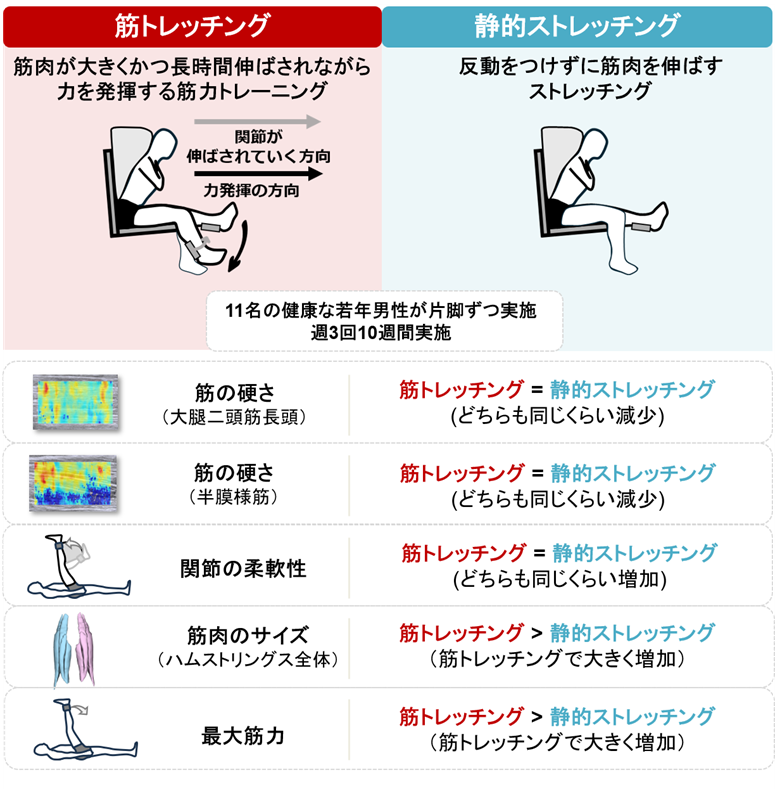
Measures related to passive mechanical properties (e.g., shear modulus) of human skeletal muscle have traditionally been believed to chronically decrease with repeated static stretching (SS). Instead, repeated eccentric contraction has recently emerged as a promising alternative for chronically decreasing muscle shear modulus. Here, we tested the hypothesis that repeated eccentric-only training (ECC) induces greater adaptations in muscle shear modulus than SS within a matched intervention period. Eleven healthy young males participated in a 10-week intervention (three sessions per week) involving knee flexor ECC (three sets of 10 repetitions performed at 50% of maximal eccentric torque) for one leg and knee-extended SS (three sets of stretching held for the same duration as training) for the other. Before and after the intervention, we assessed maximal joint range of motion (ROM), shear moduli (using ultrasound shear wave elastography), architectures (using diffusion tensor imaging), and volumes of the biarticular hamstring muscles and the maximal voluntary isometric torque of knee flexors. The local shear moduli of the biceps femoris long head and semimembranosus significantly decreased, whereas the local shear modulus of the semitendinosus remained unchanged, regardless of intervention types. Maximal joint ROM significantly increased similarly across intervention types. Additionally, greater increases in maximal voluntary torque and volumes of all biarticular hamstring muscles were observed after ECC than after SS. Our findings suggest that ECC has a similar potential to SS in inducing chronic decrease in local shear moduli of specific biarticular hamstring muscles, while simultaneously promoting gains in muscle strength, muscle size, and joint flexibility.