2026-06-17 中国科学院(CAS)
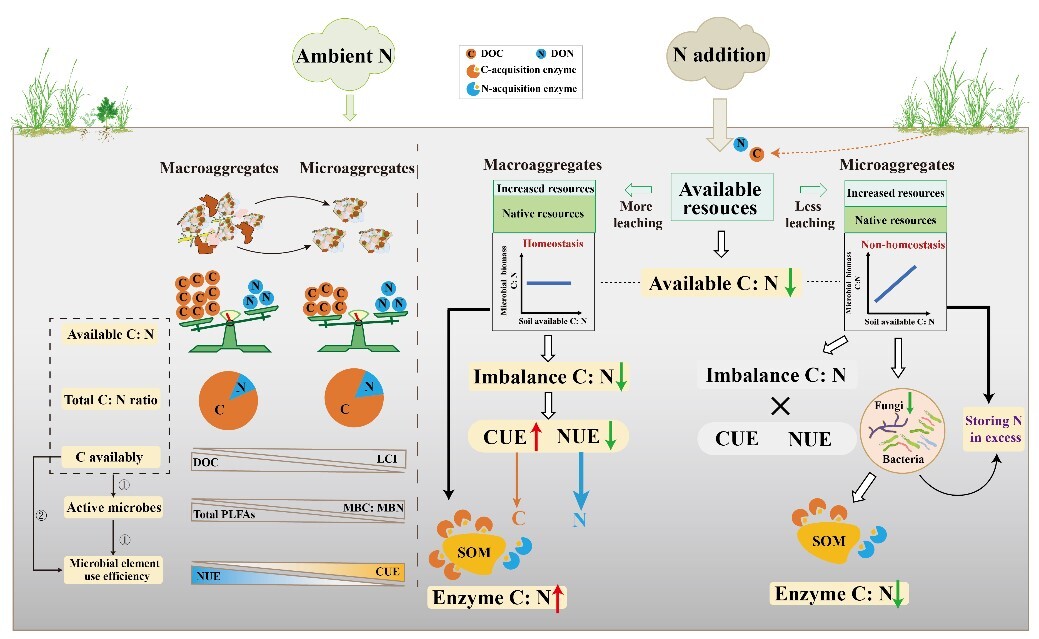
Figure 1. A conceptual diagram illustrating the effect of N addition on microbial CUE and NUE within different aggregate size fractions and the underlying mechanisms (Image by WANG Zhirui).
<関連情報>
- https://english.iae.cas.cn/research/202606/t20260617_1169166.html
- https://www.sciencedirect.com/science/article/abs/pii/S0341816226004686
窒素添加に対する凝集体特異的な微生物適応戦略が草原ステップにおける炭素および窒素利用効率を調節する Aggregate-specific microbial adaptive strategies to nitrogen addition regulate carbon and nitrogen use efficiencies in a meadow steppe
Zhirui Wang, Tianpeng Li, Changming Lu, Jiangping Cai, Xue Feng, Mikhail V. Semenov, Cong Wang, Xiaotao Lü, Heyong Liu, Osbert Jianxin Sun, Xingguo Han, Irina Kravchenko, Yong Jiang, Hui Li
Catena Available online: 20 May 2026
DOI:https://doi.org/10.1016/j.catena.2026.110258
Highlights
- N addition enhanced microbial CUE but reduced NUE in macroaggregates.
- Stoichiometric imbalances shaped microbial CUE and NUE in macroaggregates.
- N addition had minor impact on microbial CUE and NUE in microaggregates.
- Microaggregate microbes adapted to N by excess N storage and community shifts.
- Substrate availability drove microbial element use efficiency across aggregates.
Abstract
Microbes adapt to stoichiometric imbalances between their biomass and soil resources by modulating their elemental use efficiencies, thereby controlling soil carbon (C) and nitrogen (N) cycling. Anthropogenic inputs of reactive N alter soil C:N stoichiometry, potentially affecting microbial C use efficiency (CUE) and N use efficiency (NUE). However, it remains unclear how microbes inhabiting different soil aggregates, each offering distinct resource environments, adjust their CUE and NUE under N input, hindering accurate predictions of microbial-mediated C and N dynamics. To address this knowledge gap, we estimated microbial CUE and NUE within large macroaggregates (>2000 μm), small macroaggregates (2000–250 μm), and microaggregates (<250 μm) after six years of N addition in a meadow steppe. N addition exerted aggregates-size-specific effects: it increased microbial CUE but decreased NUE in large and small macroaggregates, while both indices remained unchanged in microaggregates. In the macroaggregates, microbial communities maintained stoichiometric homeostasis under N addition by coordinately adjusting their CUE and NUE to mitigate C limitation and reduced C:N imbalance. In the microaggregates, microbial communities showed a non-homeostatic response, storing excess N and shifting community composition rather than modulating their CUE and NUE. Overall, the microbial communities in the microaggregates had higher CUE than those in the macroaggregates, reflecting an inherent adaptation to the lower substrate availability in smaller aggregates. Findings in this study underscore the aggregate-scale heterogeneity of microbial adaptations to N enrichment and enhance our understanding of microbial-mediated element cycling within confined spaces.