2026-06-15 北京大学(PKU)
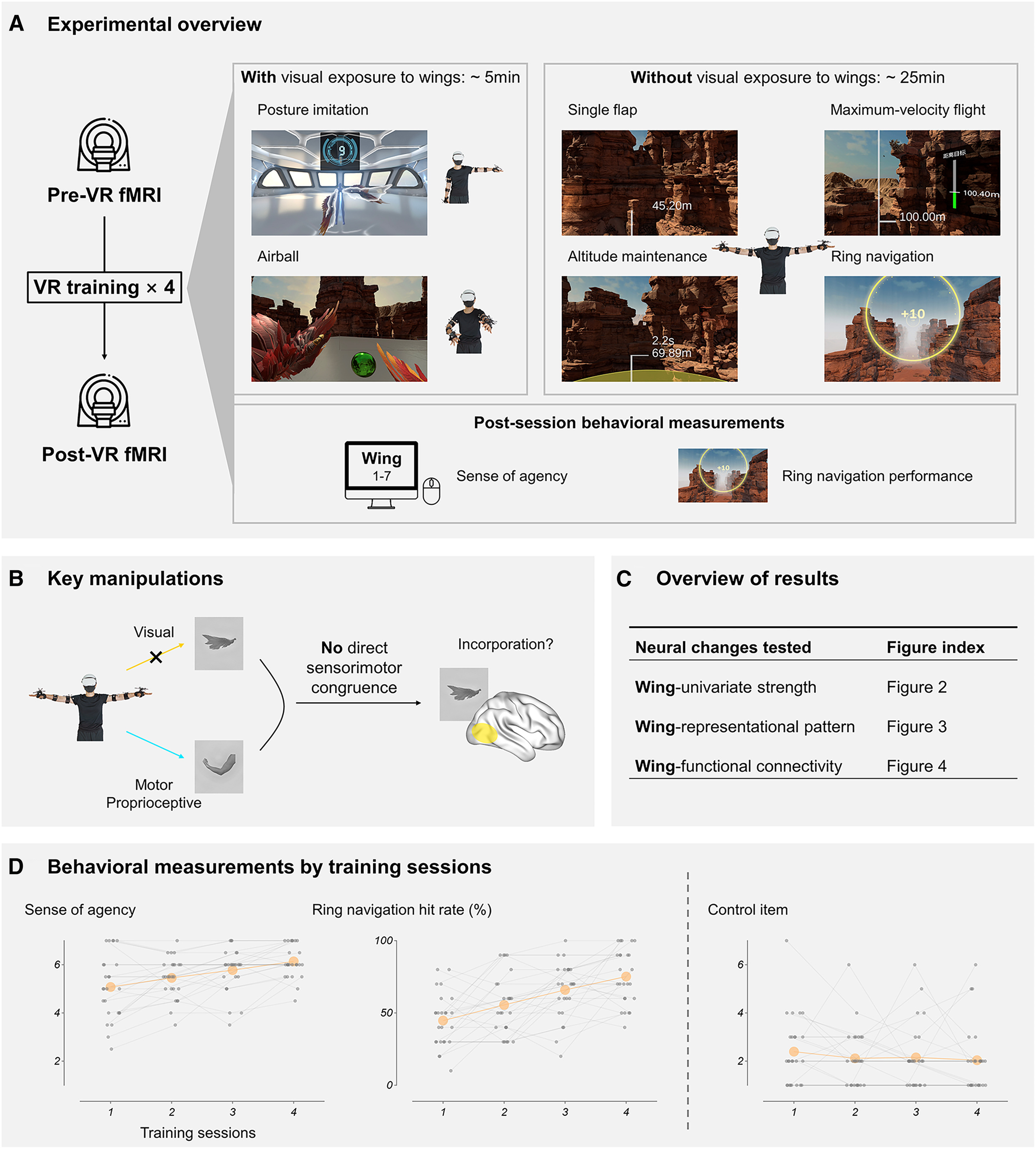
Experimental overview
<関連情報>
- https://newsen.pku.edu.cn/news_events/news/research/15580.html
- https://www.cell.com/cell-reports/fulltext/S2211-1247(26)00398-0
仮想飛行体験は翼を見たときの神経反応を変化させる Virtual flying experience changes neural responses to seeing wings
Ziyi Xiong ∙ Yiyang Cai ∙ Xiaosha Wang ∙ Kunlin Wei ∙ Yanchao Bi
Cell Reports Published: May 7, 2026
DOI:https://doi.org/10.1016/j.celrep.2026.117320
Highlights
- VR enables embodiment of illusionary wings through upper-limb control
- Occipitotemporal cortex shows wing-enhanced activation and limb-like representation
- Wing images evoke enhanced occipitotemporal-frontoparietal functional coupling
- Human visual system incorporates wings as effectors via functional-semantic coding
Summary
The human brain visually processes body parts in the occipitotemporal cortex (OTC), a category-selective organization proposed to reflect evolutionary salience. Using virtual reality (VR), we investigated how the OTC adapts to artificial body parts—virtual wings—that transcend evolutionary constraints. Participants underwent a week of VR training (four sessions), learning to control virtual wings via upper-limb movements with simulated visual feedback of flight. Comparing pre- and post-VR neural responses to wing images shows changes in the OTC, characterized by (1) increased bilateral wing-selective activation, (2) enhanced multi-voxel representational similarity between wings and upper limbs in the right OTC, and (3) strengthened task-dependent functional coupling (psychophysiological interaction) of wing stimuli between the right OTC and frontoparietal high-level somatosensory and motor associate regions. These findings show that the OTC incorporates illusionary effectors into body representations that transcend lower-level sensorimotor congruence, highlighting its role in the abstract, functional-semantic coding of visual inputs.