2026-07-21 国立精神・神経医療研究センター
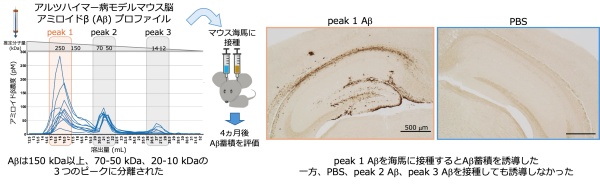
【図】 アルツハイマー病モデルマウス脳由来peak 1 AβはAβ蓄積を誘導する
<関連情報>
- https://www.ncnp.go.jp/topics/detail.php?@uid=WzFpajHpFxph1mtb
- https://academic.oup.com/braincomms/article/8/4/fcag188/8728449
アミロイドβが蓄積した脳から得られた可溶性高分子量アミロイドβ種は、脳βアミロイドーシスを誘発する Soluble high-molecular-weight amyloid-β species derived from amyloid-β-laden brains induce cerebral β-amyloidosis
Mayu Kashiwagi-Hakozaki,Hirokazu Uchigami,Yasushi Naka,Asuka Kokawa,Tatsuo Mano,Junki Cho,Kaoru Yamada,Akinori Miyashita,Norikazu Hara,Takeshi Ikeuchi,…
Brain Communications Published:20 July 2026
DOI:https://doi.org/10.1093/braincomms/fcag188
Abstract
Spatiotemporal spreading of amyloid-β peptide deposition as senile plaques is a key pathogenic process in the brains of patients with Alzheimer’s disease; however, the molecular properties of amyloid-β strains that initiate the spreading of amyloid-β peptide as aggregation seeds in vivo remain poorly understood. In this study, we discovered that the intrahippocampal injection of soluble amyloid-β species with a molecular weight of >150 kDa isolated from the brains of plaque-laden amyloid-β precursor protein transgenic mice or patients with Alzheimer’s disease using size-exclusion chromatography, dramatically accelerated β-amyloidosis in the transgenic mice brains. In contrast, intrahippocampal injection of soluble amyloid-β species with 50–70 kDa or 10–20 kDa never induced β-amyloidosis. Moreover, injection of the soluble amyloid-β species with >150 kDa into cerebrospinal fluid of young transgenic mice via the cisterna magna predominantly induced amyloid-β deposition within the wall of leptomeningeal arteries surrounding the brain, reminiscent of cerebral amyloid angiopathy. The seeding activity of the soluble high-molecular-weight amyloid-β was prevented by the immunodepletion of amyloid-β and abolished by formic acid denaturation, suggesting that these amyloid-β oligomers are crucial in inducing β-amyloidosis. Furthermore, we have shown that the soluble high-molecular-weight amyloid-β is present in the brains of patients with Alzheimer’s disease and induced β-amyloidosis. These results indicate that the soluble high-molecular-weight amyloid-β oligomers may play an important role in the spatiotemporal spreading of amyloid-β deposition in Alzheimer’s disease brains.