
2026-08-18 ミュンヘン大学(LMU)
<関連情報>
- https://www.lmu.de/en/newsroom/news-overview/news/new-building-block-combines-proteins-with-other-molecules-a4411920.html
- https://www.nature.com/articles/s41557-026-02222-6
自己組織化ハイブリッド構造のためのタンパク質-フォールダマー超分子シンソン A protein–foldamer supramolecular synthon for self-assembled hybrid architectures
Johannes Sigl,Vasily Morozov,Lingfei Wang,Janine Sachs,Eric Merlet,Eric Largy,Niklas Geue,Nicklas Österlund,Sunbum Kwon,Florian Sanchez,Léo Candela,Simon Huet,Kevin Pagel,Yann Ferrand,Céline Douat,Cameron D. Mackereth & Ivan Huc
Nature Chemistry Published:17 August 2026
DOI:https://doi.org/10.1038/s41557-026-02222-6
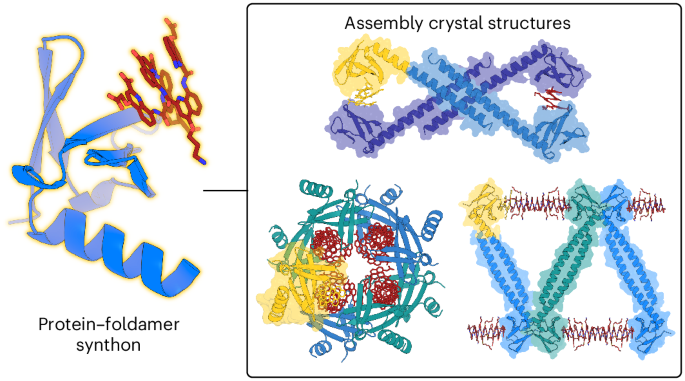
Abstract
Constructing artificial assemblies that combine proteins and synthetic ligands has been hampered by the lack of protein–ligand interfaces that are sufficiently large and organized to enable precise structural control. Here ribosome display selection is used to identify a protein that binds a helical aromatic foldamer both tightly and selectively through a sizeable surface area. We used this complex as a supramolecular synthon to create well-defined hybrid foldamer–protein architectures. Examples include foldamers that bind two proteins and hold them at a precise distance, proteins that bind two foldamers and crystals in which proteins and foldamers are connected in cyclic or infinite arrays. The modularity of aromatic foldamers brings a further dimension to protein-based assemblies.

