2026-09-10 東京大学
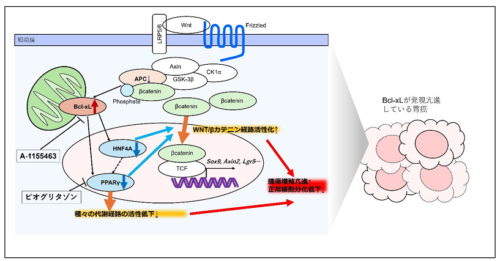
Bcl-xL による胃癌の腫瘍増殖メカニズム、および治療戦略の提案
<関連情報>
- https://www.h.u-tokyo.ac.jp/press/20260910.html
- https://www.h.u-tokyo.ac.jp/press/__icsFiles/afieldfile/2026/09/10/release_20260910.pdf
- https://www.cmghjournal.org/article/S2352-345X(26)00158-X/fulltext
Bcl-xLは、アポトーシス非依存的なWnt/β-カテニン活性化およびPPARγ抑制を介して胃腫瘍形成を促進する Bcl-xL Promotes Gastric Tumorigenesis via Apoptosis-Independent Wnt/β-Catenin Activation and PPARγ Suppression
Yukiko Oya ∙ Junya Arai ∙ Yoku Hayakawa ∙ … ∙ Tetsuro Takehara ∙ Timothy C. Wang ∙ Mitsuhiro Fujishiro
Cellular and Molecular Gastroenterology and Hepatology Published:September 8, 2026
DOI:https://doi.org/10.1016/j.jcmgh.2026.101880
Abstract
Background and Aims
The Wnt/β-catenin and YAP pathways cooperatively drive gastrointestinal tumor progression. BCL2L1, a YAP target gene, encodes the anti-apoptotic isoform Bcl-xL, which is highly expressed in multiple cancers, but its role in gastric cancer remains unclear.
Methods
We generated Mist1-CreERT; Apcflox/flox and bcl-xlflox/flox mice to study gastric tumorigenesis with or without Bcl-xL. Gastric organoids and xenografts were used to assess proliferation and downstream signaling, and findings were validated in human gastric cancer tissues and databases.
Results
Deletion of Bcl-xL significantly reduced tumor growth and proliferation in Apc-deficient tumors, organoids, and xenografts. Nuclear β-catenin and Wnt target gene expression were attenuated, partly through derepression of Hnf4a and Pparg, indicating that Bcl-xL promotes Wnt signaling. Concurrently, downregulation of Hnf4a and Pparg contributes to the inhibition of multiple metabolic pathways. In human gastric cancer, high BCL2L1 expression correlated with elevated Wnt target genes and poor prognosis, whereas PPARG expression inversely correlated with BCL2L1 and associated with favorable outcomes. Epidemiological analysis suggested that pioglitazone, a PPARγ agonist, reduced gastric cancer incidence in diabetic patients.
Conclusions
Bcl-xL promotes gastric tumorigenesis through dual mechanisms—enhancing Wnt signaling and suppressing PPARγ—and highlight Bcl-xL as a potential therapeutic target while suggesting PPARγ activation may be protective.