2026-09-10 東京科学大学
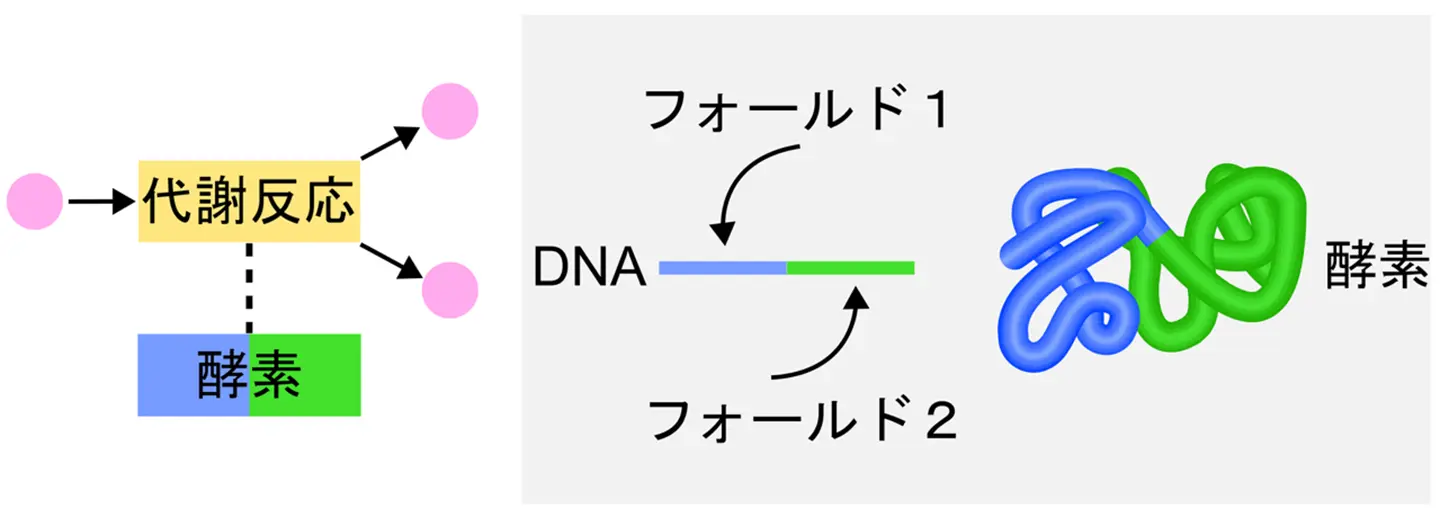
図1. 代謝反応と必要なタンパク質フォールドの対応の概念図。
<関連情報>
代謝に埋め込まれた酵素進化の歴史 The history of enzyme evolution embedded in metabolism
Tatsuya Corlett, Harrison B. Smith, Eric Smith, +1 , and Liam M. Longo
Proceedings of the National academy of Sciences Published:August 11, 2026
DOI:https://doi.org/10.1073/pnas.2609531123
Abstract
Whereas phylogenetic reconstructions are a primary record of protein evolution, it is unknown whether the deep history of enzymes is encoded at higher levels of biological organization. Here, we demonstrate that the emergence and reuse history of enzymatic folds is embedded within the web of metabolite-cofactor-enzyme interdependencies that comprise biosphere-scale metabolic reaction networks. Using a simple network analysis approach, we reconstruct the relative ordering of enzymatic fold emergence and, where possible, the first reaction(s) that each enzymatic fold catalyzed. We find that a large majority of enzymatic folds were sufficient as independent additions to open new avenues for metabolic growth. The resulting network-based histories are broadly concordant with enzyme phyletic distribution in prokaryotes, a proxy for enzyme age. Our results suggest that the earliest enzyme-mediated metabolisms were enriched for α/β proteins, likely due to their strong association with cofactor utilization, and that α-proteins preferentially emerge at later stages. The cradle-loop barrel, a member of the small β-barrel metafold, is predicted to be the founding β-fold, in agreement with analyses of ribosome structure. An examination of how the protein universe responded to the biological production of molecular oxygen reveals that the adaptation of existing enzymatic folds, not novel fold emergence, was the primary driver of metabolic evolution. This work presents a self-consistent model of metabolic and enzyme evolution, key progress toward integrating diverse perspectives into a unified history of protein evolution.