2026-09-11 マウントサイナイ医療システム(MSHS)
<関連情報>
- https://www.mountsinai.org/about/newsroom/2026/researchers-discover-rare-cortical-neurons-that-can-help-put-the-brain-to-sleep
- https://www.nature.com/articles/s41586-026-10876-y
新皮質の長距離抑制は皮質同期と睡眠を促進する Neocortical long-range inhibition promotes cortical synchrony and sleep
Jacob M. Ratliff,Geoffrey Terral,Arenski Vazquez,Stefano Lutzu,Arena Manning,Nelson Perez-Catalan,Gabriela Neubert da Silva,Soyoun Kim,Julie Mota,Matt Mallory,Bianca Stith,Charu Ramakrishnan,Gianna Mattessich,Lief E. Fenno,Tanya Daigle,David A. Stafford,Hongkui Zeng,Bosiljka Tasic,Staci Sorensen,Karl Deisseroth,John Ngai,Thomas S. Kilduff,Lucas Sjulson,Stephanie Rudolph & Renata Batista-Brito
Nature Published:09 September 2026
DOI:https://doi.org/10.1038/s41586-026-10876-y
Abstract
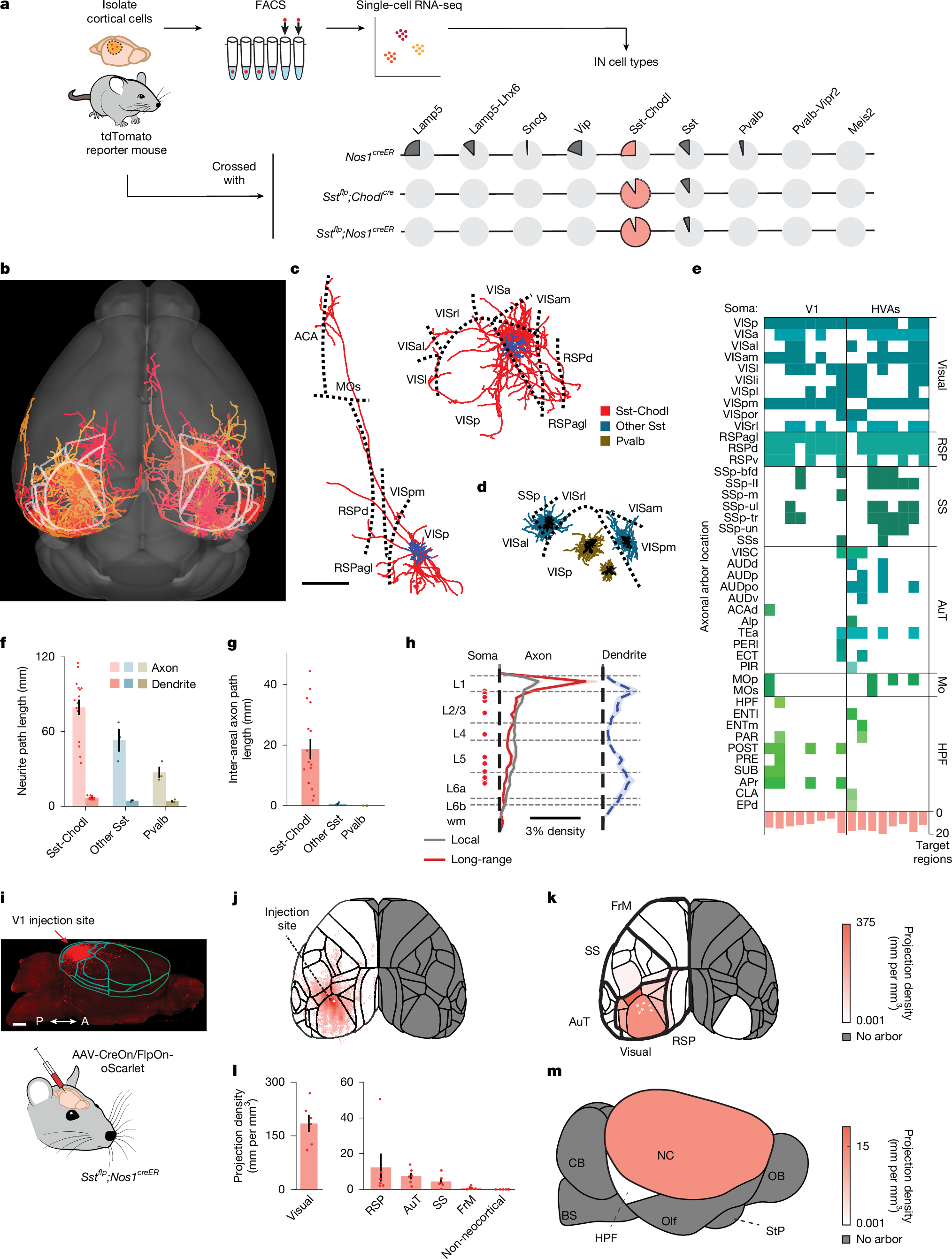
Sleep and wakefulness are associated with distinct cortical patterns of rhythmic activity1. During low-arousal states such as slow-wave sleep, synchronous low-frequency rhythms dominate activity across widespread cortical regions. Although inhibitory neurons are increasingly recognized as key regulators of cortical state2,3,4, the circuit mechanisms that coordinate synchronized activity across local and distant neocortical networks in vivo remain poorly understood. Here we show in mice that cells co-expressing somatostatin (Sst) and chondrolectin (Chodl)—which constitute a sparse and genetically distinct class of neocortical GABAergic inhibitory neurons—are selectively active during low-arousal states and mostly silent during periods of high arousal. In contrast to most neocortical inhibitory neurons, Sst-Chodl cells, despite being extremely sparse, exert widespread influence across the neocortex, through long-range axons that target multiple regions simultaneously. Selective activation of Sst-Chodl cells is sufficient to promote the multi-region cortical synchronization that is characteristic of low-arousal states and to induce sleep. Together, these findings show that long-range Sst-Chodl inhibitory neurons not only track behavioural state, but can also actively promote synchronized cortical activity and sleep behaviour, highlighting that cortical circuits have a key role in sleep regulation, alongside established subcortical mechanisms.