2026-09-02 東京科学大学
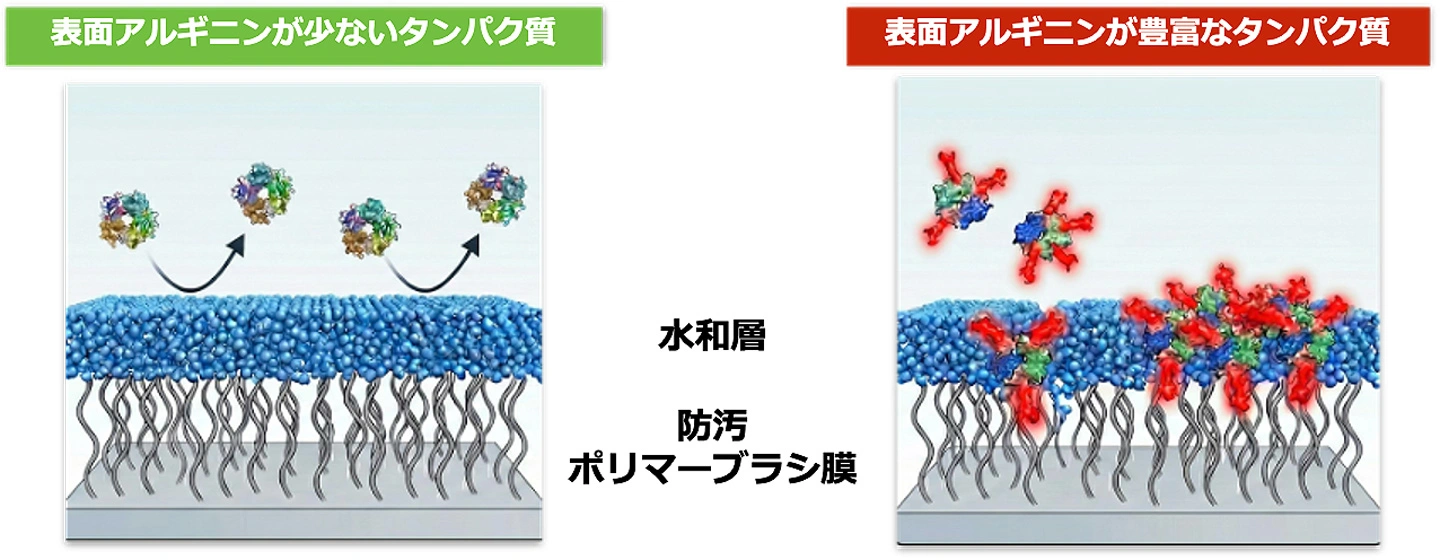
図1. 本研究で提唱した、タンパク質表面のアルギニンによるタンパク質蓄積の仕組み。
<関連情報>
- https://www.isct.ac.jp/ja/news/4ge6sxvaq8zq
- https://advanced.onlinelibrary.wiley.com/doi/10.1002/admi.70652
カオトロピック表面アルギニンは、防汚性生体材料表面におけるタンパク質コロナ形成と相関する:定量的プロテオミクスおよびタンパク質構造研究 Chaotropic Surface Arginine Correlates With Protein Corona Formation on Anti-Fouling Biomaterial Surfaces: A Quantitative Proteomics and Protein Structure Study
Ayano Nomura, Guanghao Hu, Ang Art Wei Yao, Chisato Komura, Hideharu Kurioka, Tomohiro Hayashi
Advanced Materials Interfaces Published: 24 August 2026
DOI:https://doi.org/10.1002/admi.70652
ABSTRACT
The protein corona determines the biocompatibility of medical devices, yet predicting its composition on anti-fouling surfaces remains challenging. We performed quantitative proteomic analysis (nano LC-MS/MS) of proteins adsorbed from human serum onto six model organic surfaces. Identifying over 200 proteins per surface, we found that conventional predictors, such as isoelectric point and molecular weight, failed to explain selective enrichment on non-fouling films. Statistical analysis of surface amino acid compositions revealed that arginine uniquely distinguishes enriched from diluted proteins (p = 0.005; Bonferroni-corrected p = 0.125 over 25 structural descriptors, consistent with a correlation rather than a significance-corrected effect at the α = 0.05 level). We propose, but do not yet establish causally, that surface-exposed arginine residues, via their chaotropic guanidinium groups, may contribute to the local disruption of the protective hydration layers of anti-fouling coatings, thereby facilitating protein accumulation through enhanced protein–surface and protein–protein interactions. These findings identify surface arginine as the leading candidate descriptor for selective adsorption on hydration-layer–protected biomaterials and provide a hypothesis-generating framework for the molecular basis of the Vroman effect on non-fouling surfaces.