2026-07-28 中国科学院(CAS)
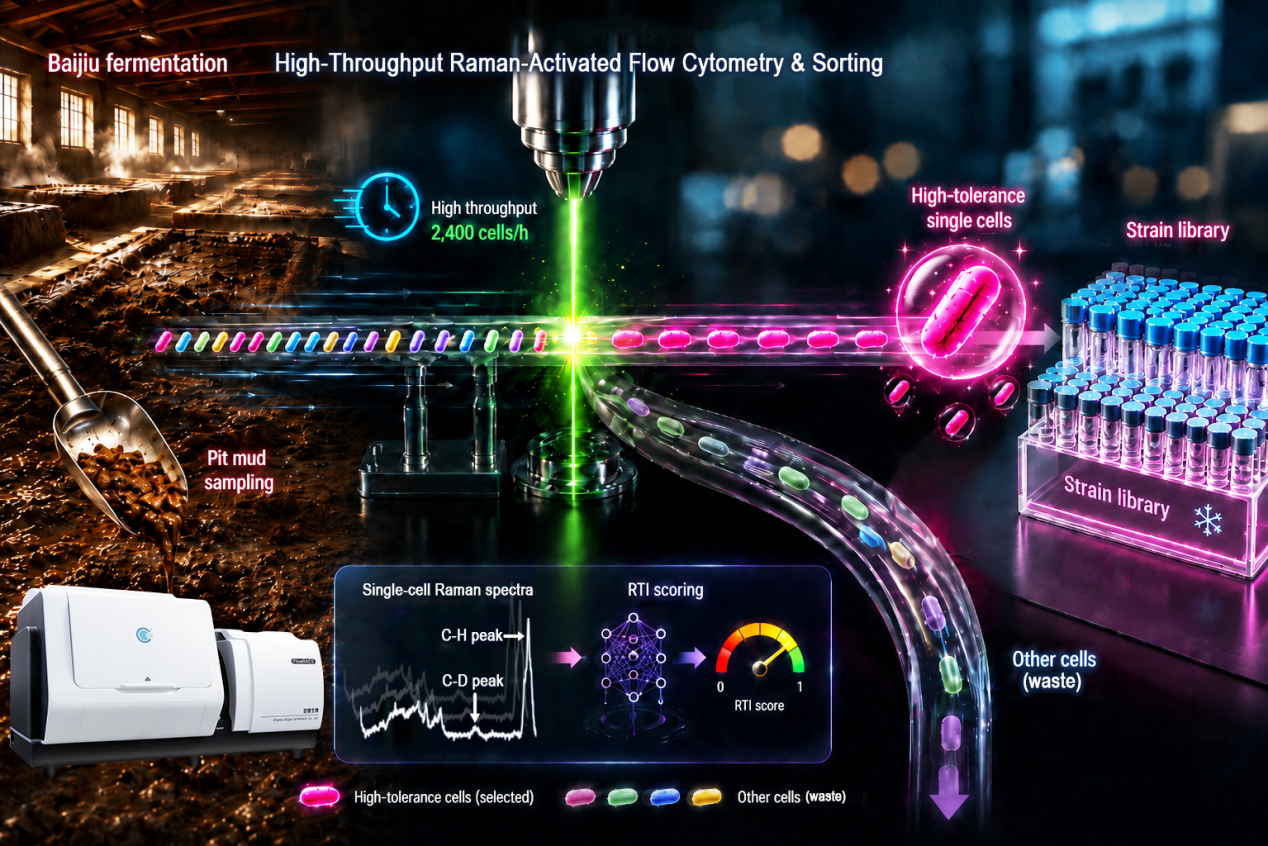
Ramanome-based “function-first” strategy for high-throughput mining of ethanol-tolerant microbes for the fermentation industry (Image by QIBEBT)
<関連情報>
- https://english.cas.cn/newsroom/research-news/202607/t20260729_1179357.shtml
- https://www.sciencedirect.com/science/article/pii/S0960852426014793
ラマン活性化細胞選別法を用いた、ピット泥微生物叢からのエタノール耐性微生物の代謝駆動型高効率採掘 Metabolism-driven and high-efficiency mining of ethanol-tolerant microorganisms from pit mud microbiota using Raman-activated cell sorting
Teng Xu, Qing Sun, Gongchao Jing, Yongming Duan, Xiaohang Wang, Xinyun Yi, Changle Wu, Huizi Zhu, Bo Ma, Jian Xu, Xiaowei Zheng, Xixian Wang, Jia Zhang
Bioresource Technology Available online: 14 July 2026
DOI:https://doi.org/10.1016/j.biortech.2026.135397
Highlights
- A metabolism-driven strategy was developed for mining ethanol-tolerant microbes.
- Successfully enriched high ethanol-tolerant strains from pit mud.
- All isolated strains showed high tolerance (RTI > 50%) to 8% ethanol.
- Transcriptome revealed distinct ethanol adaptation strategies in strains F4 and F5.
Abstract
Mining stress-tolerant microorganisms from complex microbiomes is pivotal for the development of robust microbial chassis. However, conventional culture-first methods were laborious, low throughput, and inefficient for high-performance cells. Here, we developed and applied a high-throughput microfluidic optical tweezers-based Raman-activated cell sorting (RACS) system coupled with deuterium oxide (D2O)-labelled single-cell Raman spectroscopy (SCRS). Leveraging a high screening throughput of ∼ 2,400 cells/h and a sorting accuracy of 91.3%, we successfully and efficiently enriched highly ethanol-tolerant cells from pit mud microbiomes. In a single sorting run, the system enriched 177 highly metabolic-active cells under ethanol stress before cultivation. Targeted cultivation on MRS medium yielded 6 isolates, all showing strong tolerance to 8% (v/v) ethanol in a 7 h SCRS-based assessment, whereas conventional culture-first screening achieved only 2 out 9 (22.2%) success. Genome sequencing and strain-specific transcriptomic profiling further provided molecular support for the ethanol-tolerant phenotypes of Lactiplantibacillus plantarum F4 (Raman Tolerance Index = 85.1 ± 3.41%) and Staphylococcus epidermidis F5 (RTI = 62.2 ± 1.09%). These molecular responses support the physiological relevance of the Raman screening signal. Overall, this integrated workflow achieved a 4.5-fold improvement in enrichment, and a 6.86-fold increase in assessment efficiency compared with conventional methods. Therefore, by sorting target cells based on metabolic activity in a screen-before-culture manner, D2O-RACS is a powerful and versatile platform for efficient mining of stress-tolerant cells.