2026-10-07 東北大学
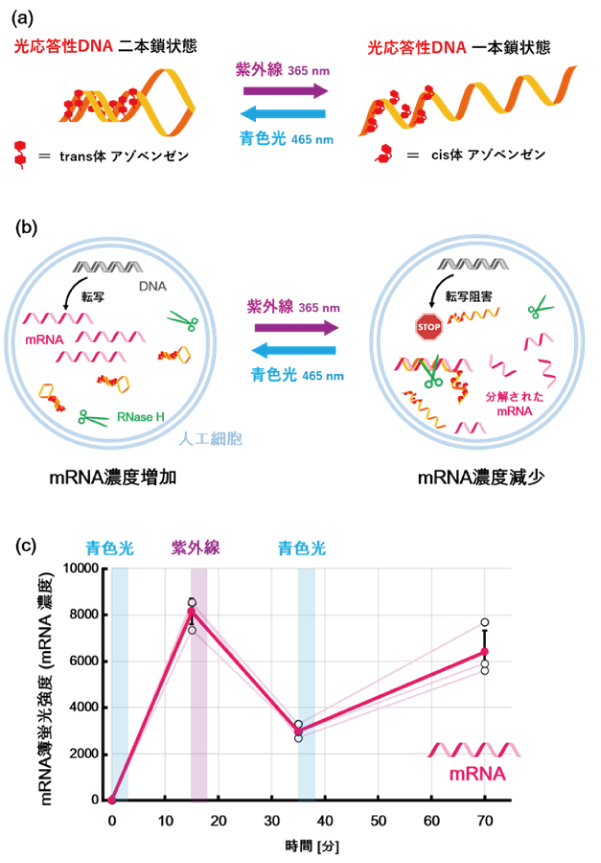
図1. 光に応答してmRNA濃度を制御する人工細胞。
<関連情報>
- https://www.tohoku.ac.jp/japanese/2026/10/press20261007-03-photocontrol.html
- https://chemistry-europe.onlinelibrary.wiley.com/doi/full/10.1002/syst.70057
人工細胞内におけるmRNA濃度切り替えのためのmRNA合成および切断の可逆的光制御 Reversible Photocontrol of mRNA Synthesis and Cleavage for mRNA Concentration Switching Inside Artificial Cells
Daichi Iwata, Keiji Murayama, Ken Komiya, Hideaki T. Matsubayashi, Keita Abe, Hiroyuki Asanuma, Satoshi Murata, Shin-ichiro M. Nomura
ChemSystemsChem Published: 17 September 2026
DOI:https://doi.org/10.1002/syst.70057
ABSTRACT
Spatiotemporal control of gene expression in response to external stimuli is a crucial technology in cell-free gene expression (CFE) and artificial cells. Most conventional control methods have focused on switching transcription ON/OFF. However, residual mRNA can persist after transcription stops, leading to continued gene expression. Active mechanisms that decrease mRNA levels are effective for achieving a sharp OFF response. Here, we report a method using azobenzene-modified hairpin DNA (AzoPinDNA) and RNase H to simultaneously and reversibly control transcription and RNA cleavage. AzoPinDNA modulates RNase H-mediated mRNA cleavage by photo-switching its duplex formation capability. Notably, we confirmed that AzoPinDNA controls both RNA cleavage and transcription. Our system achieved reversible control with a dynamic range of 2–3-fold for intact mRNA and 3.5–6.5-fold for peptide products. A rapid OFF response was realized, reducing mRNA concentration by over 50% within 20 min after UV irradiation. Furthermore, this system functioned within artificial cells (giant unilamellar vesicles), enabling external photocontrol of the concentration of translatable mRNA within the compartment. This approach, which integrally photocontrols both transcription and mRNA cleavage, represents the first method for manipulating mRNA levels at will. Applications in synthetic biology and basic medicine are anticipated.