2026-10-07 生理学研究所
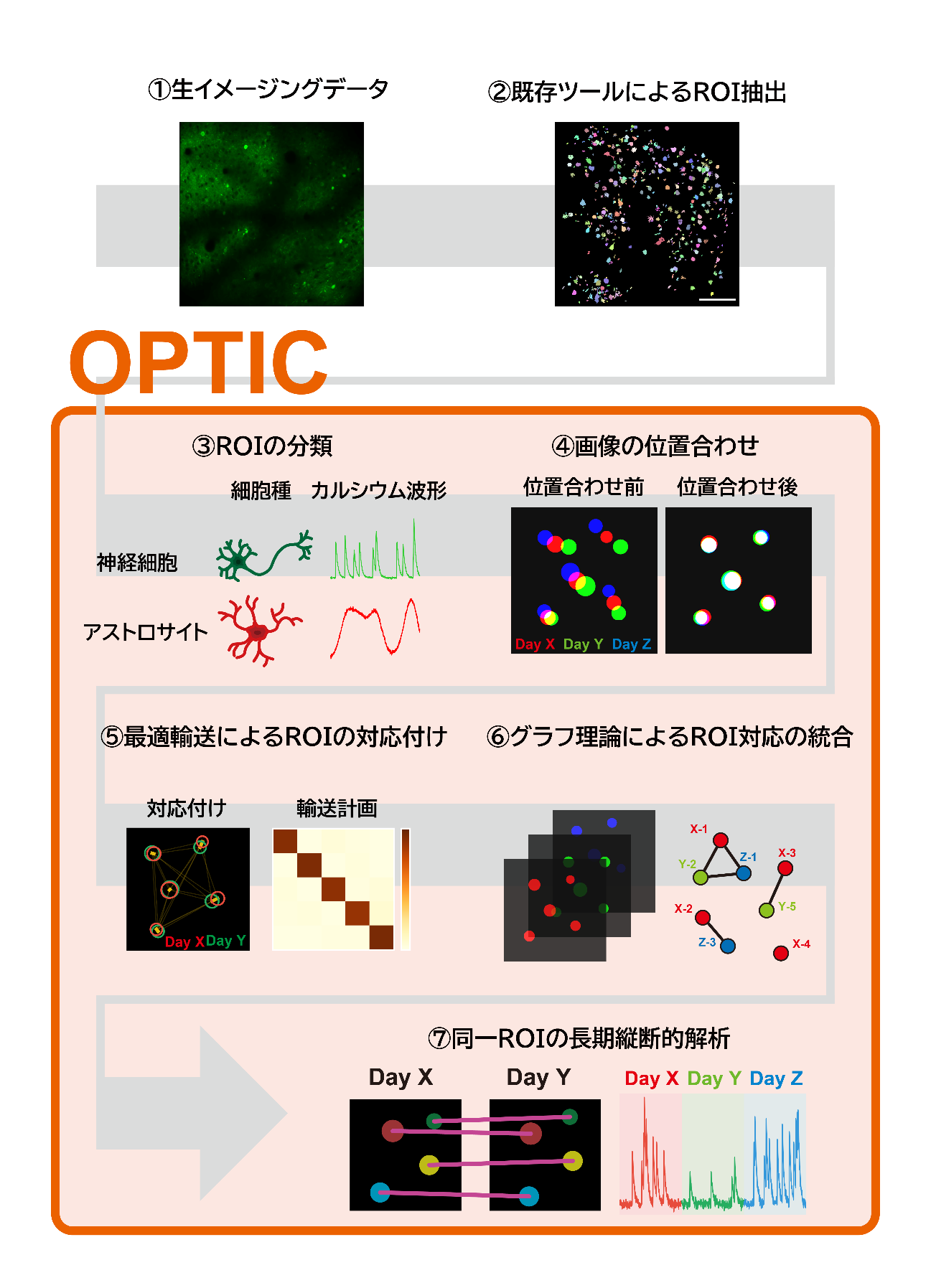
図1OPTICによるカルシウムイメージング解析の全体パイプライン
<関連情報>
- https://www.nips.ac.jp/release/2026/10/optic.html
- https://www.cell.com/cell-reports-methods/fulltext/S2667-2375(26)00316-4
OPTICを用いた多細胞カルシウムイメージングのための自動クロスセッションROIトラッキング Automated cross-session ROI tracking for multicellular calcium imaging with OPTIC
Noriaki Fukatsu ∙ Yuta Tanisumi ∙ Dennis Lawrence Cheung ∙ … ∙ Mio Inoue ∙ Andrew John Moorhouse ∙ Hiroaki Wake
Cell Reports Methods Published:October 6, 2026
DOI:https://doi.org/10.1016/j.crmeth.2026.101615
Highlights
- OPTIC is an accessible toolbox to track cells across multiple calcium imaging sessions
- Pairs image registration with optimal-transport matching of ROI centroids
- Graph-based framework resolves ROI identities across three or more sessions
- Outperforms existing methods across neurons, astrocytes, boutons, and microglia
Summary
Two-photon imaging enables minimally invasive, deep-tissue chronic observation of cellular dynamics, including neural activity, generating massive datasets that require scalable analysis. While platforms like Suite2p automate region of interest (ROI) extraction, downstream validation and cross-session ROI tracking remain bottlenecked by manual workflows. To address this, we present OPTIC (optimized toolbox for image-based cellular analysis), an open-source, Python-based platform featuring three intuitive graphical user interface (GUI) applications: OpticROICuration for basic ROI classification and integration of external curation data, OpticROITracking for automated cross-session ROI matching, and OpticRawTracking for general cell tracking, validated here on microglia. By pairing robust image registration and optimal transport-based ROI matching, OPTIC automates cross-session tracking with higher accuracy than popular alternatives like CellReg and TrackMate. Validated on in vivo datasets of calcium imaging (neurons, astrocytes, and axonal boutons) and complex cell migration (microglia), OPTIC provides a fully customizable solution requiring no programming expertise to streamline high-throughput neuroscience pipelines.