2026-10-05 東京大学
肺線維症病態における、放出自己RNAと自然免疫反応の制御機構
<関連情報>
- https://www.u-tokyo.ac.jp/content/400297326.pdf
- https://link.springer.com/article/10.1038/s44321-026-00513-6
非標準的な細胞表面MDA5による細胞外RNAの除去が、肺線維症を予防する Extracellular RNA clearance by non-canonical cell-surface MDA5 protects against lung fibrosis
Takashi Ishii, Masafumi Horie, Hirokazu Urushiyama, Yusuke Murakami, Tomoya Narita, Ryutaro Fukui, Kensuke Miyake, Akira Saito, Naomi Yamashita, Keiki Kumano, and Hidenori Kage
EMBO Molecular Medicine Published:12 October 2026
DOI:https://doi.org/10.1038/s44321-026-00513-6
Abstract
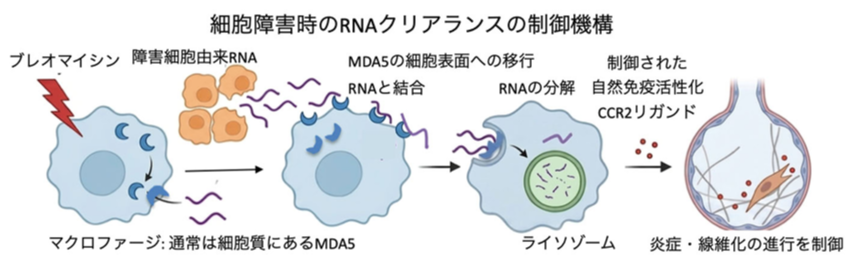
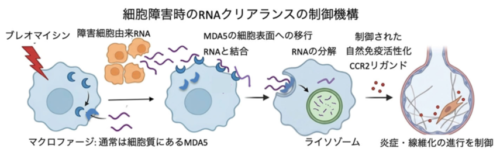
The role of innate immune receptors, specifically RNA sensors, in non-pathogen-driven lung fibrosis remains unclear. Here, we demonstrate that the cytosolic RNA sensor MDA5 could translocate to the cell surface upon bleomycin-induced damage. MDA5-deficient mice exhibited exacerbated lung fibrosis with increased IL-17A⁺ γδ T cells and neutrophils, which is independent of the canonical MAVS pathway and type I interferon signaling. Phenotypically, MDA5-deficient lung CD11b⁺ macrophages, which resemble human SPP1⁺ macrophages, showed elevated expression of CCR2 ligands. Mechanistically, cell-surface MDA5 acts as a scavenger receptor that captures extracellular self-RNA and shuttles it for lysosomal degradation. Loss of MDA5 leads to aberrant cellular RNA accumulation, triggering TLR8-dependent hyperproduction of CCR2 ligands. Analysis of human lung fibrosis samples from public datasets revealed SPP1⁺ macrophages are a major source of CCR2 ligands, suggesting their potential to activate monocytes. Our findings reveal an unrecognized protective function of MDA5 in lung fibrosis: preventing TLR8-mediated hyperinflammation through the lysosomal clearance of extracellular RNA. This mechanism provides crucial insights into the pathogenesis of fibrotic diseases like interstitial lung diseases.