
2026-08-18 北海道大学
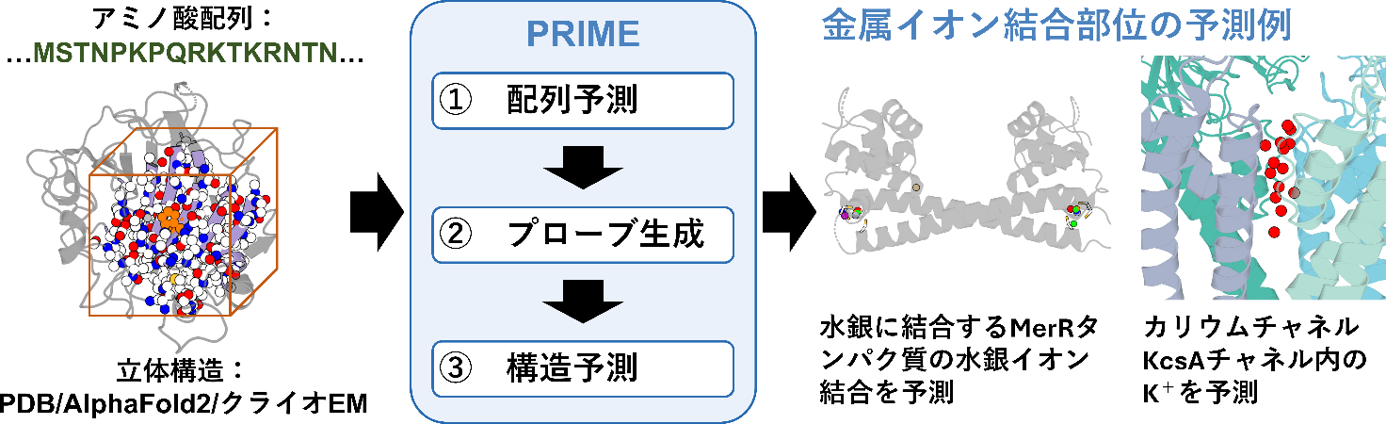
本研究の概要図
<関連情報>
- https://www.hokudai.ac.jp/news/2026/08/post-2409.html
- https://www.nature.com/articles/s41467-026-74657-x
深層学習表現を用いたプローブに基づくタンパク質金属イオン結合部位の同定 Probe-based identification of metal-binding sites using deep learning representations
Shijie Xu & Akira Onoda
Nature Communications Published:30 June 2026
DOI:https://doi.org/10.1038/s41467-026-74657-x
Abstract
Metalloproteins are essential to many cellular processes. They use metal ions as cofactors to catalyze reactions, stabilize protein structures, and mediate electron transfer. Identifying their metal-binding sites remains difficult because of the complexity of protein environments and the promiscuous binding of metal ions, and existing computational methods are limited by accuracy and data scarcity. Here we introduce PRIME, a hybrid deep learning framework that combines evolutionary and structural signals to predict metal-binding sites accurately and efficiently. PRIME employs protein language models and pre-trained structure models to extract information from protein sequences and structures, together with a probe generation algorithm that bridges sequence- and structure-based predictions by scanning candidate sites. PRIME outperforms existing methods across diverse metal ions, from abundant zinc and calcium to challenging potassium and sodium. Ablation analysis shows that pretrained structure models improve accuracy. Case studies on AlphaFold2 models further demonstrate PRIME’s potential for high-throughput metalloproteomics.

