2026-09-25 東京科学大学
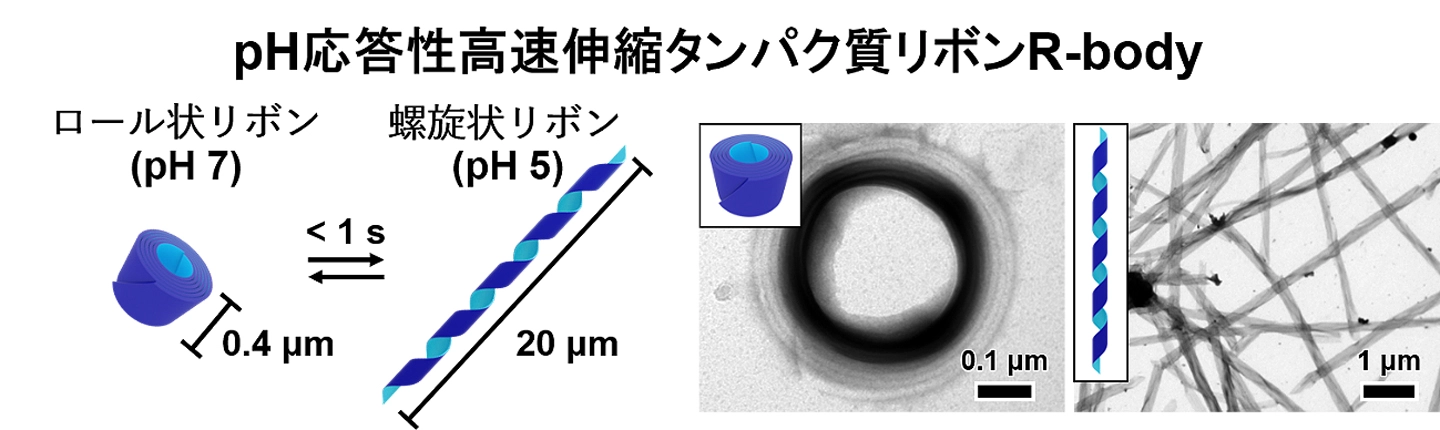
図1. タンパク質リボンR-bodyのpH応答変形
<関連情報>
- https://www.isct.ac.jp/ja/news/cklod1xnzkql
- https://pubs.acs.org/bomaf6/article-abstract/doi/10.1021/acs.biomac.6c01332/5433094/Assembly-Pathway-Regulation-Dictates-pH-Responsive
アセンブリ経路の制御がRボディタンパク質機構におけるpH応答性アクチュエーションを決定する Assembly-Pathway Regulation Dictates pH-Responsive Actuation in the R-Body Protein Machinery
Koki Date;Kosuke Kikuchi;Tatsuya Niwa;Hironari Kamikubo;Sota Masumura;Thuc Toan Pham;Keiichi Okisawa;Hideki Taguchi;Takafumi Ueno
Biomacromolecules Published:September 18, 2026
DOI:https://doi.org/10.1021/acs.biomac.6c01332
Abstract
Refractile bodies (R-bodies) are protein assemblies that form intracellular rolls and extend into spirals in response to environmental stimuli. Type 51 R-body assembles from four Reb proteins and undergoes rapid, repeatable ∼50-fold extension. Although R-bodies were described more than 70 years ago, the roles of RebC and RebD remained unclear, whereas RebA and RebB are proposed as major components. Here, we characterize the wild-type R-body (Rb_WT) and reb gene knockout mutants using integrated biophysical analyses. RebD was incorporated as a minor component, whereas RebC was not detectably incorporated into the final assembly. Mutants lacking RebA or RebB formed rolls but lost pH-dependent extension and the ordered lamellar architecture characteristic of Rb_WT. In contrast, mutants lacking RebC and/or RebD exhibited reduced roll formation and formed β-sheet-rich aggregation. Thus, pH-responsive actuation is dictated not simply by major architectural components alone, but by a regulated assembly pathway that builds the ordered lamellar architecture.