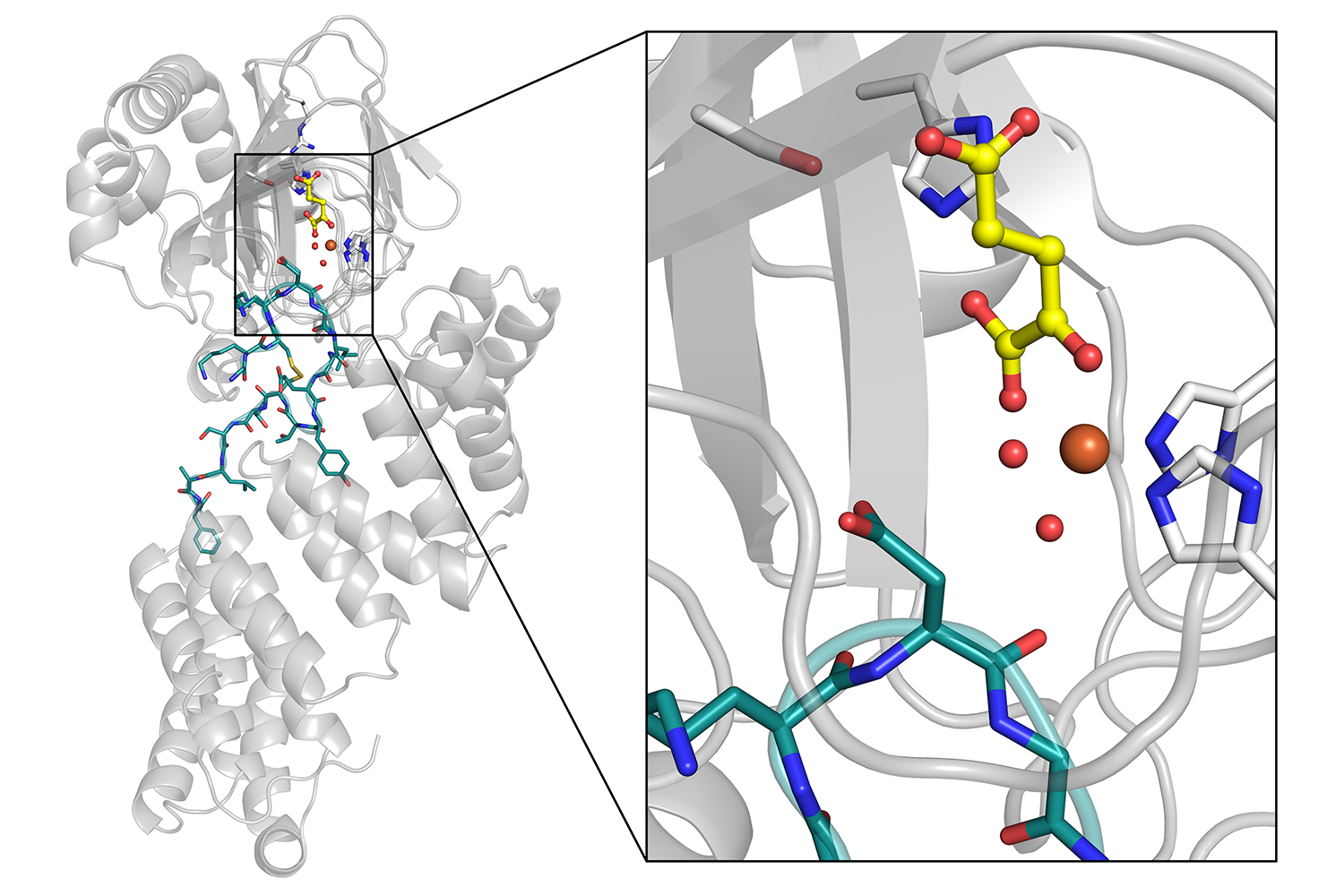
2026-10-12 ノースウェスタン大学
<関連情報>
- https://news.northwestern.edu/stories/2026/10/the-shape-of-water-defines-the-hotspot-that-starts-protein-aggregation-in-dementia
- https://www.pnas.org/doi/10.1073/pnas.2611158123
水分子を固定するホットスポットが、テンプレートとなるタウタンパク質の凝集を促進する A water-pinning hot spot drives templated tau aggregation
Chung-Ta Han, Karen Tsay, Samuel Lobo, +5 , and Songi Han
Proceedings of the National Academy of Sciences Published:October 12, 2026
DOI:https://doi.org/10.1073/pnas.2611158123

Abstract
Tau assembles into fibrillar aggregates that are pathological hallmarks of a group of neurodegenerative diseases collectively called tauopathies. Templated aggregation of naïve tau to seeding-competent fibrils that proceed from cell to cell is a key driver of prion-like progression of tauopathies. This study tests the hypothesis that tau, an intrinsically disordered protein, achieves in-register stacking to form seed-competent fibrils by a pinning action of tau to each other and/or the seed surface via a single dominant hotspot to avoid mismatch in tau stacking to fibrils. Structured solvation water has been proposed to be a signature of such hot spots at both the tau fibril-end surface and soluble tau monomers. Although jR2R3-P301L tau exhibits a heterogeneous hydration landscape in its intrinsically disordered state, with enhanced water structuring near the P301L mutation site, it is unclear whether a localized hotspot exists at the fibril end surface and surface water facilitates the initial contacts in templated aggregation. Using rapid 1H-15N SOFAST-HMQC NMR to track seed-induced aggregation of jR2R3-P301L in real time, complemented by molecular dynamics simulation of fibril surface hydration, we identify a residue-specific pinning hotspot that is prone to dewetting followed by sequential folding and incorporation of the remaining segment in a two-step dock-and-lock process. Site-specific spin labeling further demonstrates that blocking this pinning hotspot disrupts templated aggregation, leading to shorter fibrils. The identification of a dominant pinning site will facilitate the rational design of binders to effectively disrupt fibril extension or serve as diagnostic or therapeutic strategies.