2026-09-25 東北大学
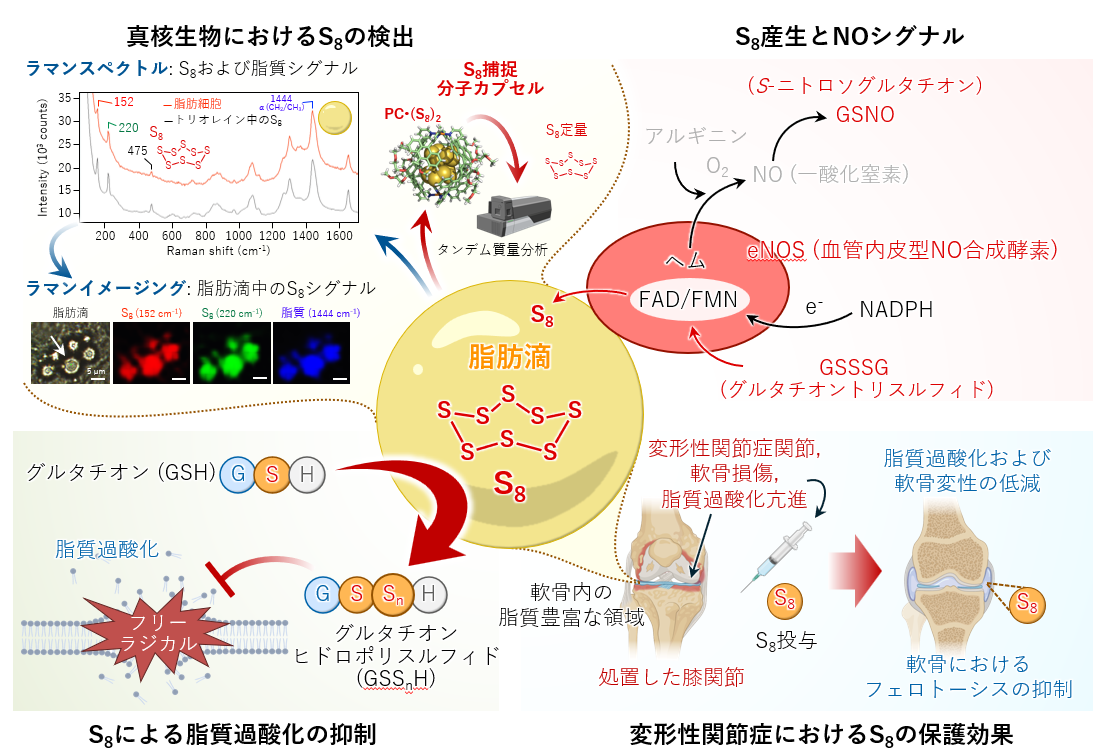
図1.哺乳類における元素硫黄S8の蓄積と細胞を守る働き
<関連情報>
- https://www.tohoku.ac.jp/japanese/2026/09/press20260925-02-octasulfur.html
- https://www.science.org/doi/10.1126/science.aec5473
哺乳類は脂質過酸化とフェロトーシスを抑制するためにシクロオクタ硫黄を生成する Mammals produce cyclo-octasulfur to suppress lipid peroxidation and ferroptosis
Uladzimir Barayeu, Seiryo Ogata, Tsuyoshi Takata, Minkyung Jung, […] , and Takaaki Akaike
Science Published:24 Sep 2026
DOI:https://doi.org/10.1126/science.aec5473
Structured Abstract
INTRODUCTION
Elemental sulfur is a central intermediate in the global sulfur cycle and is widely produced by prokaryotes, with additional evidence for its use in plants and fungi. Whether mammals synthesize, store, or use elemental sulfur, however, has remained unknown. Because mammalian cells enzymatically generate diverse reactive sulfur species, including hydropersulfides and polysulfides, we asked whether they also produce cyclo-octasulfur (S8), the most stable allotrope of elemental sulfur, for biological function.
RATIONALE
We reasoned that if mammals use elemental sulfur as a biologically meaningful metabolite, S8 should be maintained not as an incidental chemical product but as a regulated intracellular reservoir coupled to reactive sulfur metabolism. To test this possibility, we established complementary approaches: mass spectrometry using a polyaromatic capsule that captures and stabilizes S8, enabling its quantitative analysis, and Raman microscopy for the direct visualization of S8 in mammalian cells and tissues.
RESULTS
In line with established knowledge, we detected S8 in bacteria and yeast and further found it in mammalian mitochondria and lipid droplets from mouse and human cells and tissues. S8 was especially enriched in lipid droplets, corresponding by extrapolation to tens of grams or more of S8 across the human body, with particularly high levels in adipocyte-rich breast cancer tissues. We identified lipid droplet–associated endothelial nitric oxide synthase (eNOS) as a major source of S8. Recombinant eNOS converted glutathione polysulfides [e.g., glutathione trisulfide (GSSSG)] into longer sulfur chains and ultimately S8 through an NADPH-dependent sulfur-catenation reaction, where NADPH is the reduced form of nicotinamide adenine dinucleotide phosphate; in the presence of glutathione polysulfides and the canonical eNOS substrate L-arginine, this reaction also generated the nitric oxide (NO) carrier S-nitrosoglutathione (GSNO). Functionally, depletion of endogenous S8 increased lipid peroxidation and ferroptotic cell death, whereas S8 delivery protected adipocytes and endothelial cells from ferroptosis. Mechanistically, S8 reacted with abundant cellular thiols, such as glutathione (GSH), to generate antioxidant hydropersulfides and polysulfides that suppress lipid peroxidation. Local delivery of solubilized S8 into joints of mice with experimental osteoarthritis also reduced lipid peroxidation in joint tissue, suggesting a potentially protective effect.
CONCLUSION
Our findings establish that mammalian cells not only synthesize elemental sulfur as S8 but also sequester it within lipid-rich compartments at concentrations that surpass those of canonical lipophilic antioxidants such as vitamin E. This hydrophobic sulfur reservoir may provide a dynamic replenishment of redox-active persulfides, thereby linking sulfur-chain chemistry to eNOS-dependent signaling, the restraint of lipid peroxidation, and resistance to ferroptotic cell death. These results position elemental sulfur biosynthesis as an evolutionarily conserved yet metabolically adaptable antioxidant strategy, broadening the conceptual landscape of mammalian redox biology.
Abstract
Elemental sulfur is an evolutionarily ancient metabolite, yet its generation, storage, and function in animals have remained unclear. We show that mammals harbor elemental sulfur in the form of its most stable allotrope, cyclo-octasulfur (S8). We found that S8 accumulates to millimolar concentrations in mitochondrial membranes and in lipid droplets in both mouse and human cells. We further identified lipid droplet–associated nitric oxide synthase as a source of S8 biosynthesis and found that S8 accumulation in lipid droplets limits lipid peroxidation and suppresses ferroptosis. Accordingly, intra-articular injection of solubilized S8 reduces lipid peroxidation in a mouse model of osteoarthritis. Together, these findings reveal an endogenous pool of S8 in mammals that may protect cells from oxidative membrane damage by modulating cellular sensitivity to ferroptosis.