2026-09-24 国立健康危機管理研究機構, 北海道大学
ファーストインクラス HIVキャプシド阻害薬レナカパビルの作用機序を構造レベルで解明
<関連情報>
- https://www.hokudai.ac.jp/news/pdf/260924_pr2.pdf
- https://www.nature.com/articles/s41467-026-77803-7
レナカパビル誘発性HIV-1カプシド欠陥の構造的基盤:ウイルス粒子成熟過程における検討 Structural basis of lenacapavir-induced HIV-1 capsid defects during virion maturation
Hiroki Tanaka (田中大貴), Reina Morita (森田礼奈), Tomomasa Oka (岡智将), Minoru Fukushima (福島秀実), Shunsuke Kita (喜多俊介), Mina Sasaki (佐々木実奈), Katsumi Maenaka (前仲勝実) & Shinichi Machida (町田晋一)
Nature Communications Published:22 September 2026
DOI:https://doi.org/10.1038/s41467-026-77803-7
Abstract
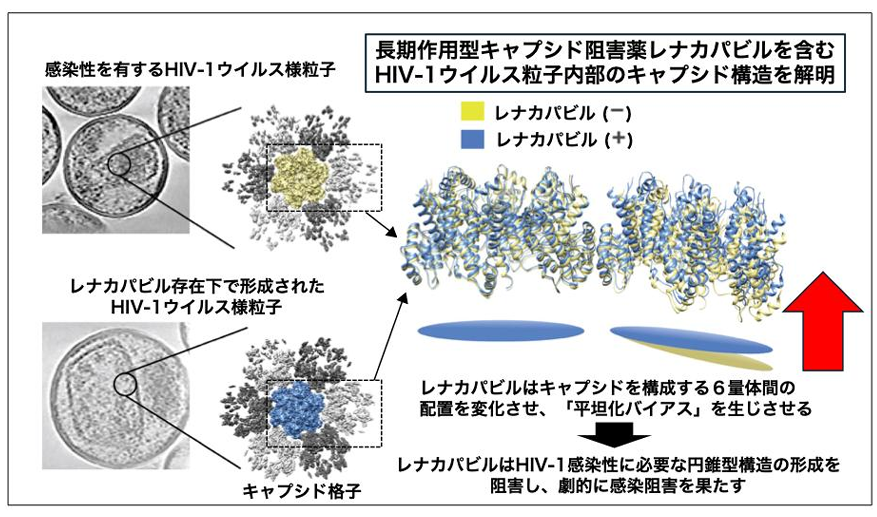
Long-acting lenacapavir (LEN) has emerged as a highly effective, potentially game-changing therapy for HIV treatment and prevention. Its mechanism of action in the early phase of HIV-1 replication, when the capsid directs key post-entry steps such as reverse transcription, nuclear import, and integration, has been well characterized. In contrast, its effects during the late phase of replication, when the capsid assembles and matures within budding virions, remain poorly understood. Here, we determine the cryo-electron microscopy structure of the mature HIV-1 capsid lattice assembled within virus-like particles in the presence of LEN. Our structural analyses reveal that LEN alters interhexamer interactions, perturbs the capsid lattice curvature, and thereby prevents the formation of a functional cone-shaped capsid. Biochemical analyses further demonstrate that LEN-containing cores lose reverse transcriptase because of compromised capsid integrity, whereas integrase and viral RNA remain associated. Functionally, viruses produced in the presence of LEN exhibit markedly reduced infectivity, low reverse transcription activity, and poor integration. Taken together, these findings provide mechanistic insights into the late-phase action of LEN and provide key directions for the design of future inhibitors.