2026-10-14 バース大学
<関連情報>
- https://www.bath.ac.uk/announcements/chemists-develop-blueprint-for-designing-powerful-fluorescent-materials-for-better-disease-detection/
- https://pubs.rsc.org/qo/article/doi/10.1039/d6qo01099g/1368208/Synthesis-of-azulene-fluorophores-reveals
アズレン蛍光体の合成により構造と物性の相関関係が明らかになる
Synthesis of azulene fluorophores reveals structure–property relationships
Chiara Faverio;João Gabriel Ribeiro;Mehmet Kaplan;Gabriele Kociok-Köhn;Tony D. James;G. Dan Pantoş;Simon E. Lewis
Organic Chemistry Frontiers Published:12 October 2026
DOI:https://doi.org/10.1039/d6qo01099g
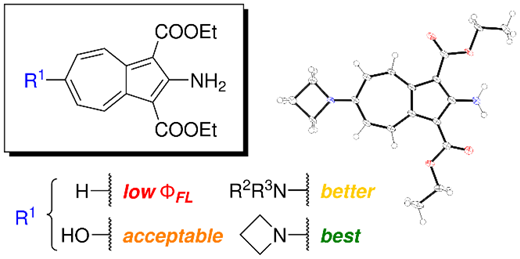
We report the synthesis, photophysical characterisation, and crystallographic analysis of a series of substituted azulenes. The compounds are analogues of the known fluorophore diethyl 2-amino-6-hydroxyazulene-1,3-dicarboxylate, in which the electron-withdrawing groups at C1 and C3 have been retained, but the electron-donating groups at C2 and C6 have been systematically varied. Correlations were observed between the nature of the C2 and C6 substituents and the fluorescence quantum yields and emission maxima; on this basis trends in the structure–property relationship have been elucidated. A novel azulene exhibiting a five-fold increase in quantum yield over the previously known fluorophore has been identified.