
2026-09-15 京都大学
<関連情報>
- https://www.kyoto-u.ac.jp/ja/research-news/2026-09-15-2
- https://www.nature.com/articles/s41538-026-01091-0
⾼温加熱した分離⼤⾖タンパク質はアミノ酸利⽤性を低下させ、マウスの社会的新奇性を変化させる High-temperature-treated soy protein isolate reduces amino acid availability and alters social novelty in mice
Tomoko T. Asai,Takayo Mannari-Sasagawa,Yuichi Yabe,Mami Yamada,Hitoshi Takamura,Noriko Horii-Hayashi,Satoshi Mochizuki,Mayumi Nishi & Kenji Sato
npj Science of Food Published:03 September 2026
DOI:https://doi.org/10.1038/s41538-026-01091-0 Early Provide
Abstract
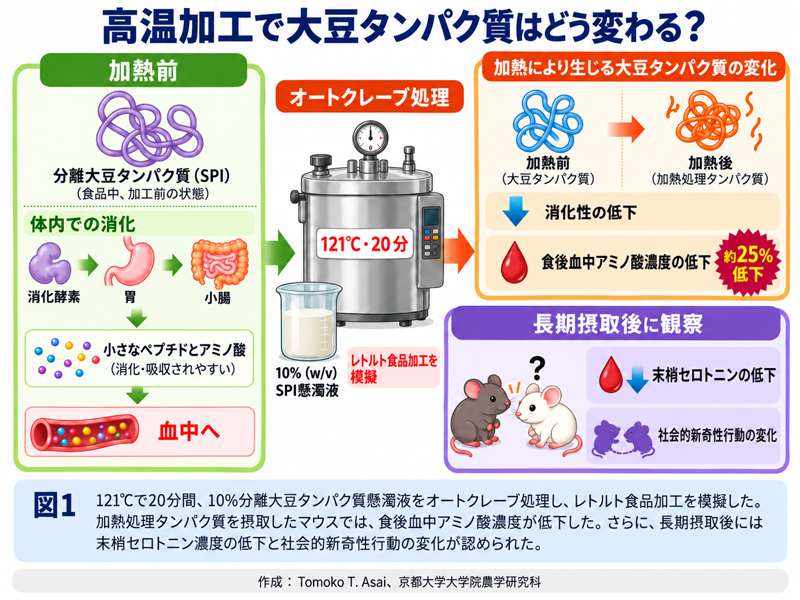
High-temperature (HT) treatments above 100 °C are important in food processing; however, their effects on the nutritional value of moist heat-treated proteins are less understood. Therefore, this study examined the impact of HT at 121 °C on soy protein isolate (SPI) in water. After 20 min of HT treatment, most amino acid levels in SPI decreased significantly, despite minimal nitrogen loss. HT also increased insoluble protein and larger soluble peptides after in vitro digestion. Mice administered HT-treated SPI showed lower serum levels of free amino acids, thereby reducing bioavailability. Long-term feeding with a 20% protein diet based on HT-treated SPI impaired social novelty recognition and decreased peripheral serotonin levels, while anxiety-like behavior, object close-range exploration, sociability, and serum tryptophan (Trp) remained unaffected. These findings indicate that HT treatment not only reduces the nutritional value of SPI but may also generate Maillard-type compounds or modified peptides that interfere with Trp metabolism and social behavior.

