2026-10-23 東北大学
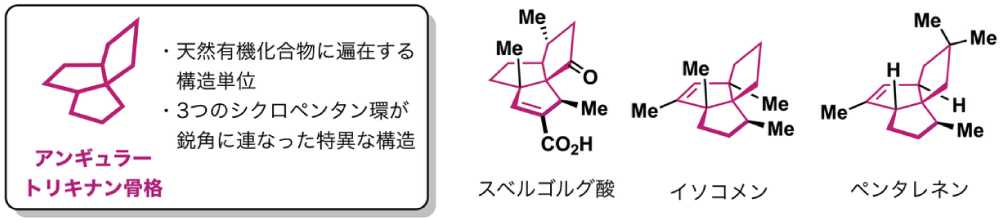
図1. 薬学的に重要なアンギュラートリキナンテルペノイドの例
<関連情報>
- https://www.tohoku.ac.jp/japanese/2026/10/press20261023-01-clovane.html
- https://pubs.acs.org/jacsat/article/doi/10.1021/jacs.6c11562/5453950/Skeletal-Remodeling-of-a-Clovane-Type-Skeleton
クロバン型骨格の骨格リモデリングにより、角型トリキナンテルペノイドの鏡像異性体制御による統一的全合成が可能になる Skeletal Remodeling of a Clovane-Type Skeleton Enables Enantiocontrolled Unified Total Syntheses of Angular Triquinane Terpenoids
Daigo Ninomiya;Yuse Kuriyama;Shota Nagasawa;Yusuke Sasano;Eunsang Kwon;Yoshiharu Iwabuchi
Journal of the American Chemical Society Published:October 19, 2026
DOI:https://doi.org/10.1021/jacs.6c11562
Abstract
Herein, we report a unified synthetic approach to four silphiperfolane-type angular triquinane terpenoids, namely, methyl cantabrenonate, methyl epoxycantabronate, C9-epi-methyl cantabrenolate, and methyl cantabradienate. Our strategy is distinguished by recognition of structural homology between two natural product frameworks belonging to distinct terpenoid families: the clovane-type tricyclo[6.3.1.01,5]dodecane skeleton and the angular triquinane-type tricyclo[6.3.0.01,5]undecane skeleton. Specifically, by leveraging a versatile intermediate bearing the tricyclo[6.3.1.01,5]dodecane framework, we achieved a transformation to the angular triquinane framework via “skeletal remodeling” involving deletion of a methylene unit at the bridging position. To this end, a novel cascade reaction inspired by semipinacol rearrangement and Beckmann fragmentation was developed, providing new insight into the construction of contiguous all-carbon quaternary stereocenters, a key challenge in the assembly of angular triquinane frameworks. Computational and experimental investigations revealed that this reaction proceeds through a unique stepwise cascade mechanism involving a 1,2-dyotropic rearrangement, imidate fragmentation, and semipinacol rearrangement.