2026-09-25 東北大学
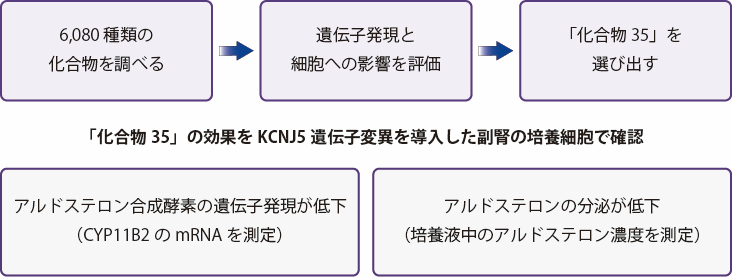
図1. 化合物35を見いだした研究の流れと主な結果
多数の化合物から候補を絞り込み、KCNJ5のL168R変異を導入した培養細胞で評価しました。化合物35は、CYP11B2のmRNA量とアルドステロンの分泌量を低下させました。
<関連情報>
- https://www.tohoku.ac.jp/japanese/2026/09/press20260925-05-aldosterone.html
- https://www.sciencedirect.com/science/article/pii/S0006291X26013501
KCNJ5変異副腎皮質細胞における脱分極誘導性CYP11B2発現およびアルドステロン産生を抑制する新規低分子化合物の同定 Identification of a novel small-molecule compound that suppresses depolarization-induced CYP11B2 expression and aldosterone production in KCNJ5 mutant adrenocortical cells
Yuri Otsubo, Hiroki Shimada, Keita Hoshi, Ryo Ito, Thanh Phuong Nguyen, Hiroyuki Yamakoshi, Kosuke Ohsawa, Hirofumi Ueda, Hidetoshi Tokuyama, Yoshiro Saito, Yoshiharu Iwabuchi, Takayuki Doi, Yasuhiro Nakamura, Akira Sugawara, Atsushi Yokoyama
Biochemical and Biophysical Research Communications Available online: 12 September 2026
DOI:https://doi.org/10.1016/j.bbrc.2026.154584
Highlights
- HTS of 6080 compounds identified compound 35 as a lead suppressing CYP11B2 in KCNJ5.
- Compound 35 suppressed CYP11B2 mRNA and aldosterone without inhibiting Ca2+ influx.
- Compound 35 reduced NURR1 and NGFIB, acting downstream of Ca2+ and upstream of NR4A.
- Compound 35 spared CYP11B1, showing selectivity over CYP11B2 enzyme inhibitors.
- Compound 35 is a novel lead for KCNJ5 mutation-associated primary aldosteronism.
Abstract
Primary aldosteronism (PA) is one of the most common causes of secondary hypertension, with aldosterone-producing adenomas (APAs) accounting for approximately half of cases. In most APAs, somatic mutations in ion channel or pump genes constitutively activate Ca2+ signaling through membrane depolarization, driving overexpression of the aldosterone synthase CYP11B2 and excess aldosterone production. Although KCNJ5 mutations represent the most prevalent somatic driver of APA pathogenesis, existing pharmacotherapies—including mineralocorticoid receptor antagonists (MRAs) and CYP11B2 enzyme inhibitors—have limitations in efficacy and selectivity, and are associated with notable adverse effects, indicating an urgent need for novel strategies that suppress CYP11B2 expression at the transcriptional level through a distinct mechanism of action. To address this need, we performed high-throughput screening of a compound library using a KCl stimulation-dependent CYP11B2 reporter system, with multi-step filtering incorporating cytotoxicity evaluation and validation in doxycycline-inducible KCNJ5-L168R mutant-expressing cells. This approach identified compound 35 (2-benzylidene-5-allyladamantan-1-ol) as a lead candidate. Compound 35 suppressed CYP11B2 mRNA expression and aldosterone secretion in KCNJ5-L168R mutant cells without inhibiting KCl-induced Ca2+ influx, demonstrating that its mechanism of action lies downstream of Ca2+ entry. Compound 35 also reduced NURR1 and NGFIB expression, pointing to a mechanism upstream of NR4A-dependent CYP11B2 induction. Notably, compound 35 showed no significant effect on CYP11B1 mRNA expression, suggesting selectivity at the transcriptional level that is mechanistically distinct from the structural similarity-based selectivity challenges faced by CYP11B2 enzyme inhibitors. These results identify compound 35 as a chemically tractable lead with a mechanism of action distinct from MRAs, Ca2+ channel blockers, and CYP11B2 enzyme inhibitors, providing a starting point for the development of transcriptional suppressors of CYP11B2 as a novel therapeutic strategy for KCNJ5 mutation-associated PA.