2026-09-10 中国科学院(CAS)
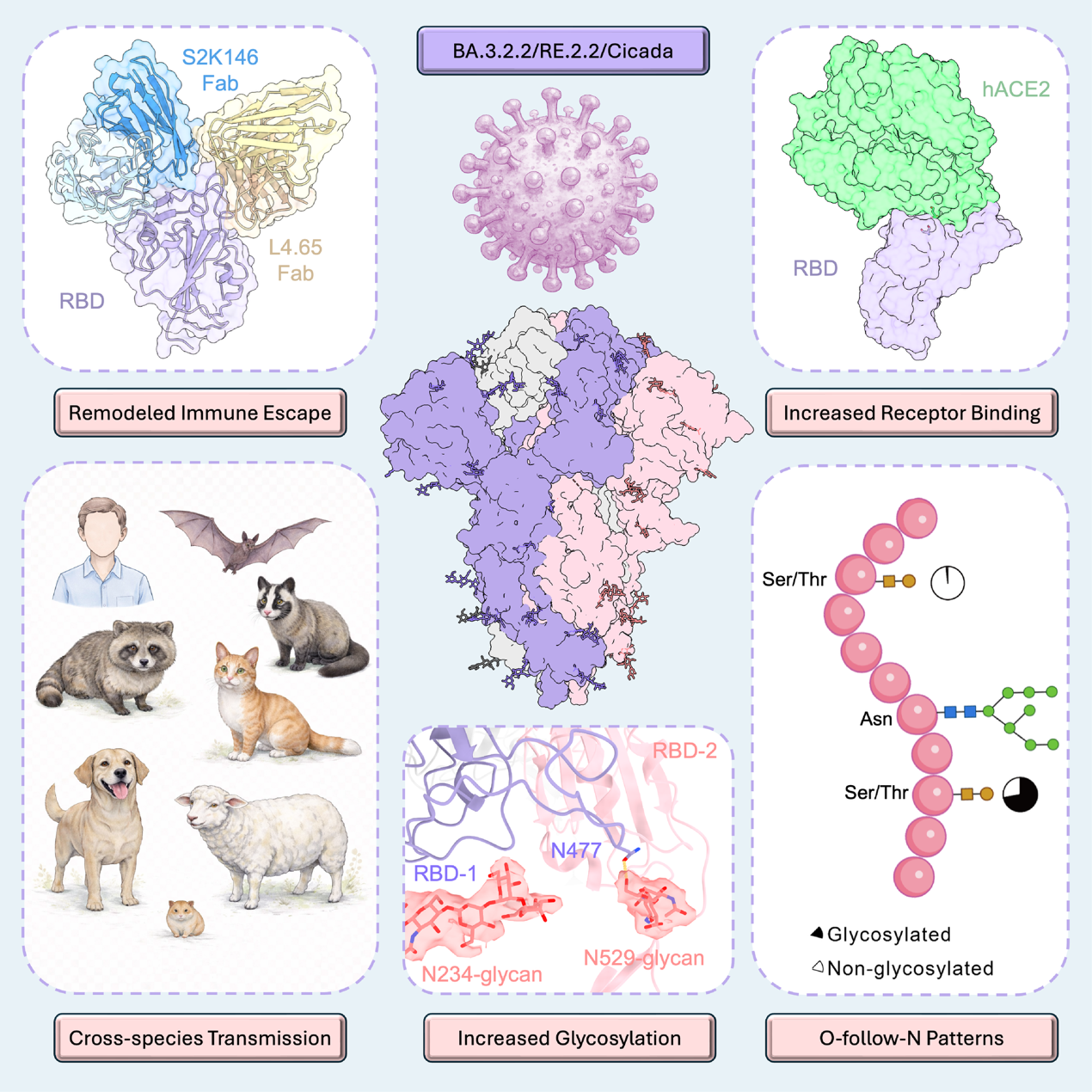
Structural features, receptor recognition, and glycosylation profiling of SARS-CoV-2 sub-variant BA.3.2.2/RE.2.2. (Image by Prof. GAO George Fu’s group)
<関連情報>
- https://english.cas.cn/newsroom/research-news/202609/t20260908_1192775.shtml
- https://www.pnas.org/doi/10.1073/pnas.2614163123
受容体結合とスパイク糖鎖修飾の増加、急増するSARS-CoV-2亜型BA.3.2.2/RE.2.2/Cicadaの免疫回避機構の再構築 Increased receptor binding and spike glycosylation, remodeled immune escape of surging SARS-CoV-2 subvariant BA.3.2.2/RE.2.2/Cicada
Linjie Li, Linh Nguyen, Hao Qu, +8 , and George Fu Gao
Proceedings of the National Academy of Sciences Published:September 8, 2026
DOI:https://doi.org/10.1073/pnas.2614163123
Abstract
SARS-CoV-2 continues to evolve. The subvariant BA.3.2 (Cicada), a derivative of the Omicron BA.3 subtype first detected in late 2024, harbors multiple spike protein mutations, ORF7 and ORF8 deletions, and has recently evolved sublineages (BA.3.2.1 and BA.3.2.2), rendering it a critical target for epidemiological surveillance. The BA.3.2.2 sublineage, represented by RE.2.2, shows a marked upward trend in late 2025. Using surface plasmon resonance, we found that RE.2.2’s spike (S) protein receptor-binding domain (RBD) exhibits relatively high affinity for human receptor angiotensin-converting enzyme 2, with structural analysis identifying the R493Q reverse mutation as the key determinant. Pseudovirus infection and antibody neutralization assays demonstrated that RE.2.2 exhibited a distinct neutralization profile compared to contemporaneous dominant subvariants. Notably, several antibodies that previously lacked neutralizing activity (e.g., S2K146 and L4.65) to other subvariants regained neutralizing potency against RE.2.2, which was associated with key mutations including G446D. Profiling of RE.2.2 RBD binding to ACE2 orthologs across species showed no significant difference in species tropism from the representative Omicron BA.1. Importantly, RE.2.2 exhibits the newly emerged N-linked glycosylation at spike protein N529 (absent in all other subvariants), a modification potentially associated with immune evasion or spike protein conformational dynamics. In addition, we corroborated the “O-follow-N” glycosylation observation as previously reported, where O-linked glycans preferentially localize near N-glycosylation sites, implying coordinated glycan organization as an extra layer of spike regulation. These findings illuminate the evolutionary characteristics, functional changes, and the constrained virus immune escape of BA.3.2.2 (RE.2.2), providing critical insights into antibody development and variant surveillance.