2026-09-10 コペンハーゲン大学(UCPH)
<関連情報>
- https://news.ku.dk/all_news/2026/08/researchers-identify-genetic-clues-that-could-reveal-aggressive-prostate-cancer/
- https://www.nature.com/articles/s41586-026-10468-w
統合されたシグネチャは前立腺癌における変異プロセスを定義する Integrated signatures define mutational processes in prostate cancer
Andreas J. Gruber,André V. Olsen,Barbara Hernando,Kevin C. L. Cheng,Clarissa Gerhäuser,Marina Torres,Francesco Favero,Daria Kiriy,Ángel Fernández-Sanromán,Juan Maria Roldan-Romero,Lucy Barton,Diogo Pellegrina,G. Steven Bova,Daniel S. Brewer,Mark N. Brook,Benedikt Brors,Adam Butler,Géraldine Cancel-Tassin,Niall M. Corcoran,Olivier Cussenot,Abraham Gihawi,Etsehiwot G. Girma,Vincent J. Gnanapragasam,Anis A. Hamid,Pan Prostate Cancer Group (PPCG),… Joachim Weischenfeldt
Nature Published:09 September 2026
DOI:https://doi.org/10.1038/s41586-026-10468-w
Abstract
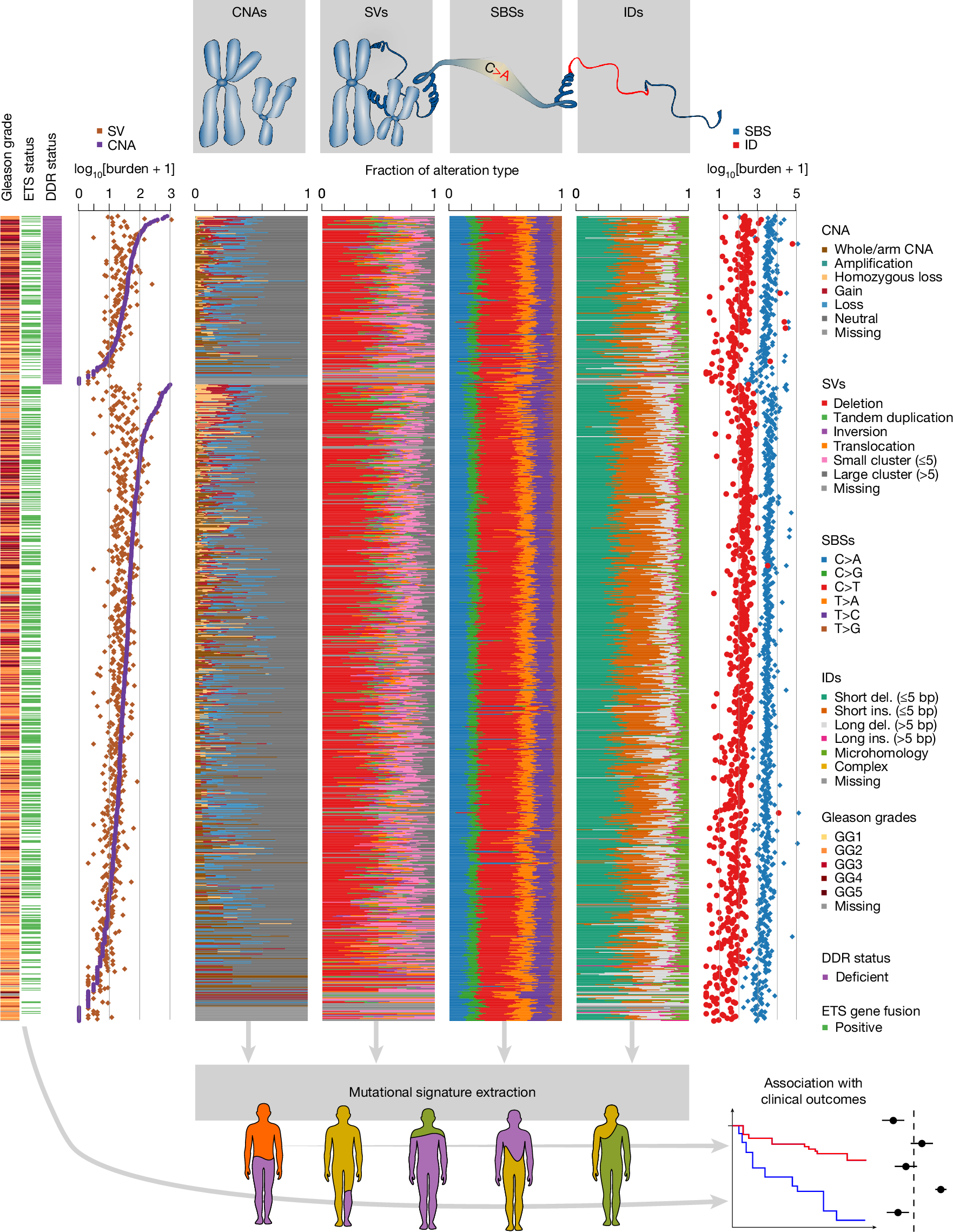
Prostate cancer follows a long and heterogeneous disease course with incompletely understood aetiology1. Here we dissect the mutational processes shaping the genomes of 959 donors from the Pan Prostate Cancer Group and assess their clinical relevance. By integrating de novo extracted single-base substitution, insertion–deletion and copy-number signatures with six novel complex structural variant signatures, we identify eight integrated mutational footprints (IMFs) that collectively explain the mutational processes in 85% of primary prostate cancer genomes. IMFs were strongly influenced by regional biases in the genome, most prevalently androgen receptor-mediated mutagenesis and replication stress. Four IMFs, present in 37% of primary tumours, were significantly associated with shorter time to metastasis. These included reactive oxygen-species-driven mutagenesis and both canonical and non-canonical homologous recombination deficiency, the latter being enriched in patients of African ancestry. Extending to the metastatic setting, we found that IMFs predicted sensitivity to androgen receptor pathway inhibitors. Taken together, our study delineates the aetiologies and mutational processes that drive the genomic and clinical heterogeneity of prostate cancer, introduces IMFs as a unifying framework, and highlights their potential to improve both risk stratification and biomarker-guided treatment selection.