2026-04-27 神戸大学
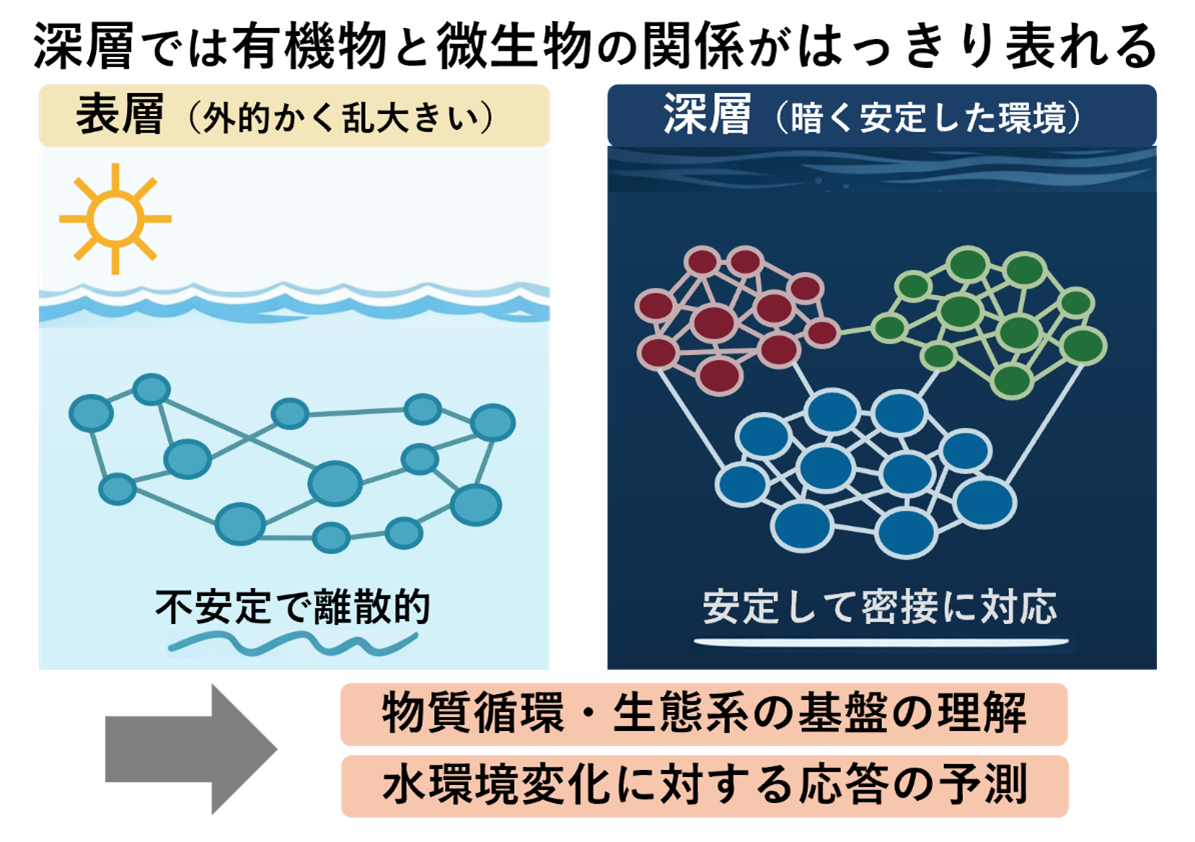
図1. 琵琶湖の表層と深層における有機物(分子式)と微生物(細菌類)の関係の模式図 ©木田森丸(CC BY-NC)
<関連情報>
- https://www.kobe-u.ac.jp/ja/news/article/20260427-67776/
- https://aslopubs.onlinelibrary.wiley.com/doi/10.1002/lno.70374
深海のカップル:深層淡水湖の酸素化された深水層における溶存有機物と微生物の関連性 Couples in the deep: Dissolved organic matter–microbial linkages in the oxygenated hypolimnion of a deep freshwater lake
Morimaru Kida, Ayuri Ohira, Yusuke Okazaki, Yasuhiko T. Yamaguchi, Akiko S. Goto, Kazuhide Hayakawa, Hiroshi Nishimura
Limnology and Oceanography Published: 27 April 2026
DOI:https://doi.org/10.1002/lno.70374
Abstract
The interaction between dissolved organic matter (DOM) and microbial communities is a critical yet understudied driver of biogeochemical cycling in aquatic ecosystems. Understanding these interactions is essential to elucidating chemical and microbial dynamics that sustain ecosystem functioning. Here, we combined non-targeted ultrahigh-resolution mass spectrometry (FT-ICR MS)-based environmental metabolome analysis with microbiome analysis to conduct the first comprehensive investigation of DOM–microbe linkages in both the epilimnion (5 m and thermocline) and oxygenated hypolimnion (60 and 85 m) of a deep freshwater lake throughout the stratification period, with Lake Biwa (Japan) as a model system. To facilitate the interpretation of DOM–microbe networks, we developed an integrated compound category classification (IC3) framework for assigning molecular formulae (MFs) to putative compound categories. Using a compositional data analysis framework with proportionality-based association, we identified covarying MFs and bacterial taxa in the hypolimnion, which exhibited substantially more complex networks than the epilimnion. These networks encompassed 1704 MFs and 14 bacterial ASVs, representing the majority of total FT-ICR MS peak intensity and 22% of the total ASV abundance, underscoring stronger DOM–microbe coupling in deep waters. Several hypolimnion specialist lineages exhibited cluster-specific associations with N-rich and oxidized MFs, consistent with niche differentiation within deep-water heterotrophy. Although network edges do not resolve causality, these patterns provide testable hypotheses about substrate preferences and metabolic pathways shaping hypolimnetic DOM. Our study offers the first high-resolution insights into DOM–microbe associations in the hypolimnion of a deep freshwater lake and establishes a framework for more efficient and robust analyses of such interactions.