2026-06-02 中国科学院(CAS)
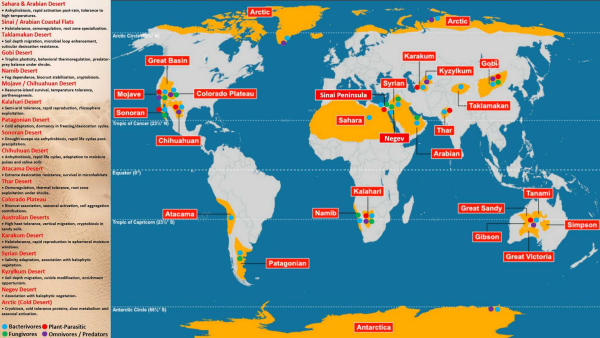
Overview of nematode diversity, distribution and adaptations in desert regions. (Image by XIEG)
<関連情報>
- https://english.cas.cn/newsroom/research-news/202606/t20260602_1160363.shtml
- https://www.sciencedirect.com/science/article/abs/pii/S0012825226000930
砂漠の守護者たち:地球上で最も過酷な生態系に生息する土壌線虫の知られざる世界 Global guardians of the desert: The unseen world of soil nematodes in Earth’s most extreme ecosystems
Waqar Islam, Fanjiang Zeng, Mohammed O. Alshaharni, Zhang Zhihao
Earth-Science Reviews Available online: 28 March 2026
DOI:https://doi.org/10.1016/j.earscirev.2026.105482
Abstract
Desert ecosystems, which occupy nearly one-third of Earth’s terrestrial surface, are shaped by extreme abiotic constraints that severely limit biological activity. Soil nematodes, as the most abundant and functionally diverse metazoans in these environments, are hypothesized to play critical but poorly quantified roles in arid-land biogeochemistry. This review synthesizes global research to evaluate the mechanisms enabling nematode persistence and their functional contributions to desert soil processes. We specifically examine: (i) patterns of taxonomic and functional diversity across desert biomes; (ii) survival strategies, including anhydrobiosis, dormancy, and osmolyte regulation, that confer tolerance to osmotic and thermal extremes; and (iii) how nematode trophic interactions (bacterivory, fungivory, parasitism, and predation) directly influence carbon mineralization, nitrogen turnover, and plant–soil feedbacks. Evidence from case studies across the Sinai, Taklamakan, Mojave, and Inner Mongolian deserts reveals both universal adaptations and region-specific functional traits. A critical analysis identifies major research gaps, notably the lack of in situ quantification of metabolic activity, the under-characterization of lipid biochemistry in anhydrobiotic survival, and the need to integrate nematode dynamics into soil food-web and ecosystem models. By framing nematodes as key regulators of nutrient cycling and ecosystem resilience, this review establishes a mechanistic basis for their use as essential bioindicators and functional drivers in predicting desert ecosystem responses to global change.