2026-06-03 中国科学院(CAS)
<関連情報>
- https://english.cas.cn/newsroom/cas-in-media/202606/t20260603_1161054.shtml
- https://academic.oup.com/jpe/article/19/3/rtaf189/8340811
高山草原における季節的な干ばつ下での、異なる開花群における形質-生殖資源配分経路 Trait-reproductive allocation pathways of different flowering groups under seasonal drought in alpine meadows
Mingli Ding,Yao Wei,Yuzhang Li,Jianyu Ma,Jingya Zhang,Jiangqin Song,Huiying Liu,Hao Wang,Zhenhua Zhang
Journal of Plant Ecology Published:24 November 2025
DOI:https://doi.org/10.1093/jpe/rtaf189
Abstract
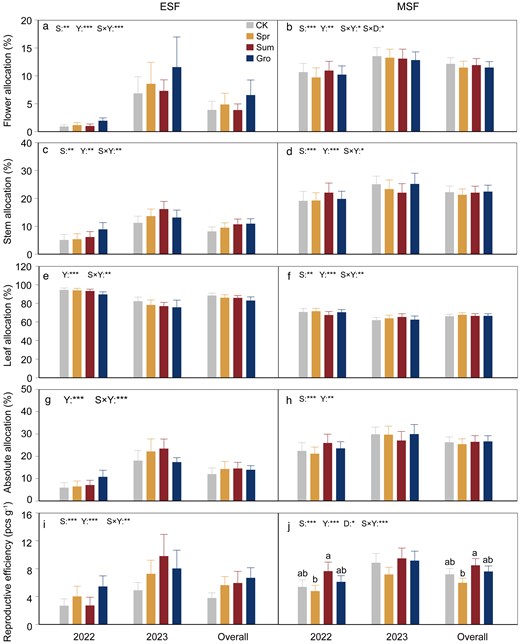
Climate change intensifies seasonal droughts in alpine meadows on the Qinghai-Tibet Plateau, impacting the adaptability of key plant functional groups. However, how plant functional groups with different flowering phenologies adjust their reproductive allocation through trait-based strategies remains poorly understood. This study examined the effects of spring, summer, and whole growing season drought on reproductive strategies of early-spring flowering (ESF) and mid-summer flowering (MSF) plant functional groups. Results revealed that spring drought significantly reduced the reproductive efficiency of MSF plants, whereas summer drought resulted in higher reproductive efficiency compared to spring drought. ESF plants exhibited greater resilience than MSF plants across all seasonal drought treatments, highlighting the advantage of their drought-avoidance strategy. Under whole growing season drought, ESF plants adopted conservative resource-use strategies, including decreased specific leaf area (SLA) and increased leaf carbon to nitrogen ratio (C/N), carbon to phosphorus ratio (C/P), and leaf dry matter content (LDMC). In contrast, MSF plants experienced phosphorus (P) limitation and height reductions. Notably, whole growing season drought induced interannual cumulative effects in MSF plants, such as increased LDMC and decreased SLA, indicating higher morphological plasticity. Furthermore, ESF plants enhanced flower allocation through both increased P availability and C/N (nutrient-sensitive strategy). For MSF plants, flower allocation was directly regulated by leaf nitrogen content (LNC), indirectly enhanced through resource reallocation from decreased plant height (morphology-integrated strategy). This study elucidates the covariation patterns between functional trait and reproductive allocation in ESF and MSF plants under seasonal drought, providing a mechanistic framework for predicting alpine ecosystems responses to future droughts.