2026-07-29 オックスフォード大学
<関連情報>
- https://www.ox.ac.uk/news/2026-07-29-monkey-friendships-with-dogs-deer-and-pigs-offer-clues-to-the-evolutionary-origins
- https://link.springer.com/article/10.1007/s10329-026-01281-0
霊長類における異種間社会行動:ペット飼育の進化的起源に関する考察 Heterospecific social behavior in primates: insights into the evolutionary roots of pet-keeping
Cyril C. Grueter,Fany Roncin,K. Anne-Isola Nekaris,Jill Pruetz,Richard McFarland,Sabit Hasan,Malgorzata Arlet,Timothy M. Eppley,Susan M. Cheyne,Vincent Nijman,Eckhard W. Heymann,Pascal R. Marty,Chiara De Gregorio,Walter Akankwasa,Lakshani Weerasekara,Jerome Micheletta,Ikki Matsuda,Luciana I. Oklander,M. Tarik Kabir,Nicolas Gorostiaga,Chengfeng Wu,Lyna Rachid Martin,Sabina Koirala,Annette Lanjouw,… Paul A. Garber
Primates Published:21 July 2026
DOI:https://doi.org/10.1007/s10329-026-01281-0
Abstract
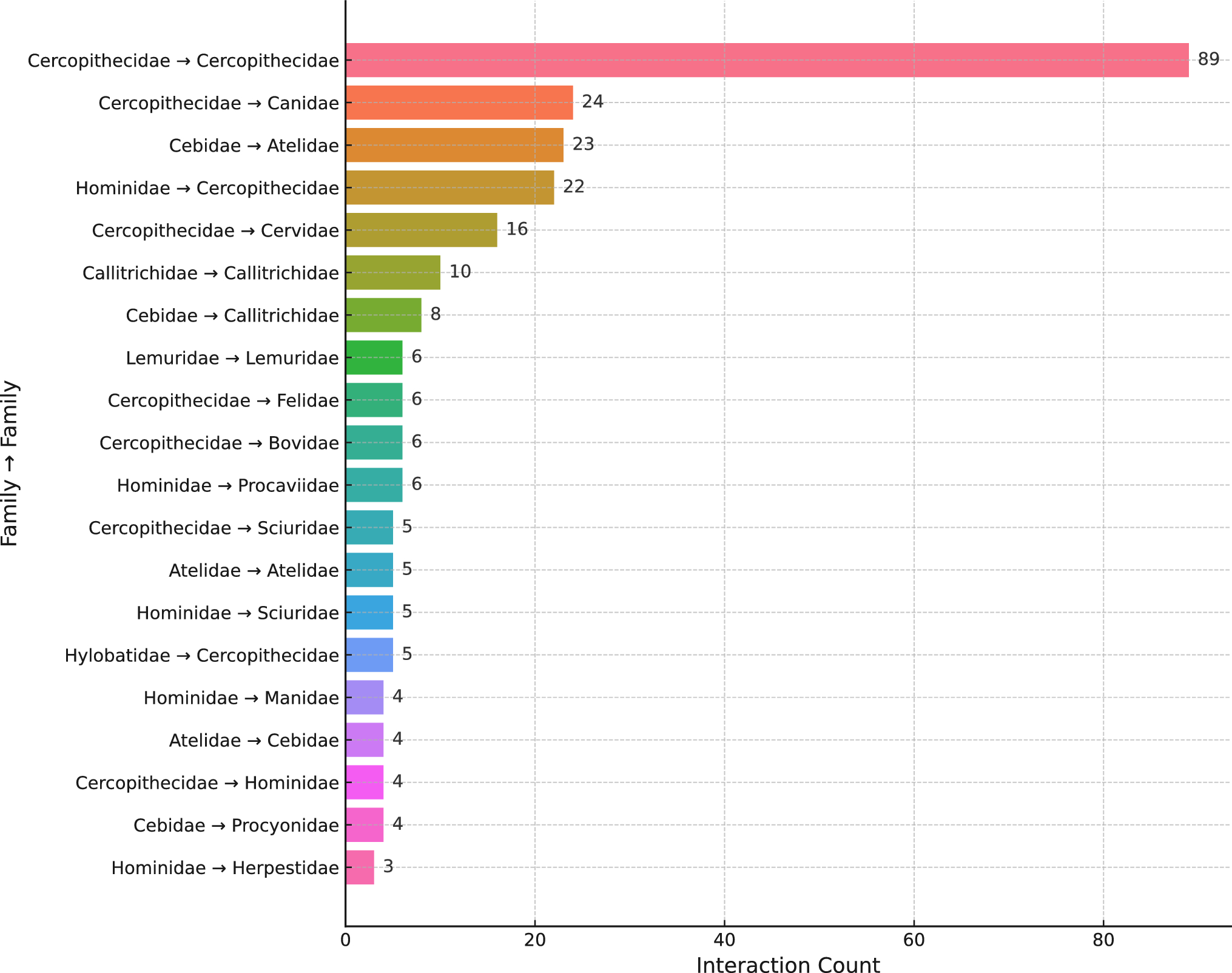
Primate interspecific interactions with both other primates and non-primate species range from predator–prey dynamics to affiliative behaviors such as grooming, play, and carrying. While many primates participate in interspecific associations or commensal relationships, to our knowledge interspecific social interactions have never been systematically synthesized. Here, we present the first comprehensive review of such interactions, compiling 427 cases from the literature, media sources, and a global survey of primatologists. These involved 88 primate species and 127 non-primate species (including mammals, birds, reptiles, amphibians, malacostracans, and insects) across wild (n = 311) and captive (n = 111) contexts. The most frequent interactions occurred within or between primate families (e.g., Cercopithecidae–Cercopithecidae, Cebidae–Atelidae), though affiliative behaviors were also directed toward distantly related taxa such as dogs and birds. Play (n = 139) and grooming (n = 136) were most common. Juveniles and infants predominantly engaged in play, while adult females were more likely to groom. Adult males were less affiliative overall. Contrary to expectations, affiliative behaviors were not more often directed toward immature than adult heterospecifics. Primates were the initiators in most interactions. These findings offer new insights into the diversity and contexts of heterospecific sociality in primates and suggest that some behavioral tendencies relevant to later forms of human–animal companionship – such as caregiving, tolerance, and exploratory play – may be more widespread among primates than previously recognized.