2026-08-04 成育医療研究センター
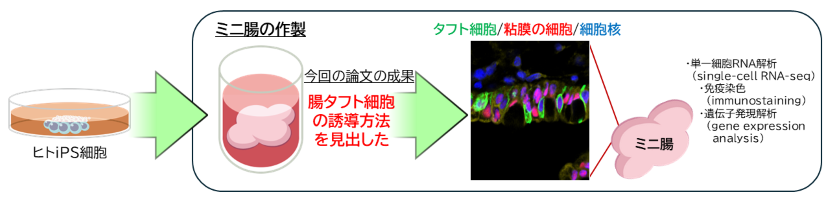
【図1:ミニ腸を活用したヒトタフト細胞研究の流れ】
<関連情報>
- https://www.ncchd.go.jp/press/2026/0804.html
- https://www.sciencedirect.com/science/article/pii/S2772572326001834
多能性幹細胞由来のミニ腸管によって明らかになった、ヒト腸管タフト細胞の特異な特徴 Unique Human Intestinal Tuft Cell Features Revealed by Pluripotent Stem Cell-Derived Mini-Guts
Masaya Tsukamoto, Tomoyuki Kawasaki, Kenji Ishiwata, Hideaki Morita, Akihiro Umezawa, Hidenori Akutsu
Castro Hep Advances Available online: 20 July 2026
DOI:https://doi.org/10.1016/j.gastha.2026.101062
Abstract
Background & Aims
Intestinal tuft cells are rare chemosensory epithelial cells critical for mucosal immunity. However, the molecular features of human intestinal tuft cells remain incompletely defined due to limited access to human tissue and known species-specific differences from murine models. We sought to establish a human tuft cell–enriched intestinal organoid system derived from pluripotent stem cells.
Methods
Human pluripotent stem cell–derived intestinal organoids containing epithelial, stromal, and neural components were subjected to Notch pathway inhibition and Th2 cytokine stimulation to promote tuft cell differentiation. Induced tuft cells were analyzed by immunofluorescence, quantitative PCR, and single-cell RNA sequencing, followed by integrated transcriptomic comparison with primary human small intestinal tuft cells.
Results
Tuft cell–enriched organoids were reproducibly generated from three independent human pluripotent stem cell lines. Integrated single-cell transcriptomic analyses demonstrated strong concordance between in vitro–derived and primary human tuft cells. The organoid-derived tuft cells exhibited distinct molecular features, including low and non-enriched IL-25 expression and predominant DCLK2 expression, distinguishing them from murine tuft cells. Under defined experimental conditions, murine-reported regulatory mechanisms, including BMP-dependent negative feedback and goblet cell–mediated lateral inhibition, were not recapitulated.
Conclusion
We establish a human pluripotent stem cell–derived intestinal organoid model that enables enrichment and molecular characterization of human tuft cells. This platform provides a human-specific system for elucidating molecular programs governing tuft cell differentiation and epithelial–immune signaling.