2026-04-23 京都大学iPS細胞研究所
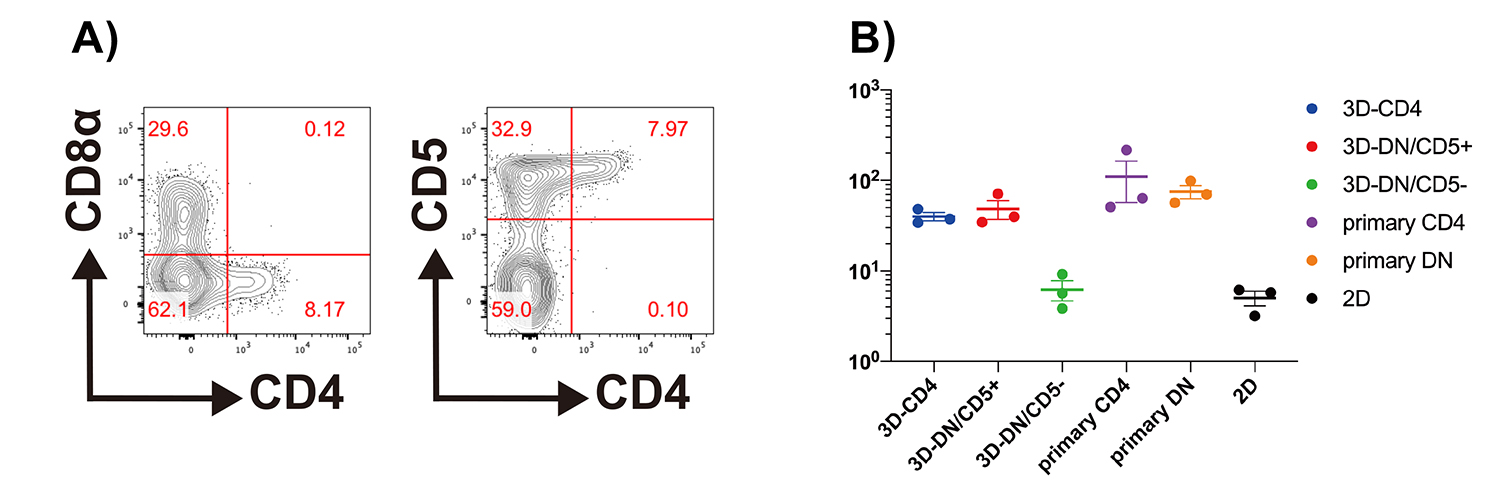
図1. ATO法によるiNKT細胞の誘導
<関連情報>
- https://www.cira.kyoto-u.ac.jp/j/pressrelease/news/260423-150000.html
- https://www.nature.com/articles/s42003-025-09462-1
人工胸腺オルガノイド培養により、機能的なiPSC由来CD4+不変ナチュラルキラーT細胞が生成される Artificial thymic organoid culture generates functional iPSC-derived CD4+ invariant natural killer T cells
Sara Shiina,Tatsuki Ueda,Shoichi Iriguchi,Yasushi Uemura & Shin Kaneko
Communications Biology Published:09 January 2026
DOI:https://doi.org/10.1038/s42003-025-09462-1
Abstract
Invariant NKT (iNKT) cells have a T-cell receptor that is common to all individuals and are activated by recognizing glycolipids on MHC class I-like CD1d molecules. Activated iNKT cells are known to exert anti-tumor effects through the activation of other immune cells and have attracted attention as promising T cells for eliciting anti-tumor immunity. However, securing a sufficient number of iNKT cells is an obstacle to treatment because iNKT cells are a very small cell population, less than 0.1% of the peripheral blood lymphocytes. Although previous studies have demonstrated redifferentiation of a large number of CD4–CD8– double-negative iNKT cells from induced pluripotent stem (iPS) cells in two-dimensional monolayer cultures, CD4+ single-positive (CD4SP) iNKT cells could not be induced. Here we show CD4SP iNKT cells can be obtained by three-dimensional (3D) organoid culture (3D-CD4+ iNKT cell). We additionally describe 3D-CD4+ iNKT cells show antigen-specific helper functions, as they proliferate, produce interferon-γ/interleukin-4 (IFN-γ/IL-4), and induce dendritic cell maturation in response to α-galactosylceramide. Furthermore, they reverse the inhibition of T cell proliferation induced by immunosuppressive macrophages in an antigen-specific manner. Collectively, 3D-CD4+ iNKT cells may become an adjuvant T-cell source to enhance current T-cell immunotherapy against solid tumors.