2026-06-17 コペンハーゲン大学(UCPH)
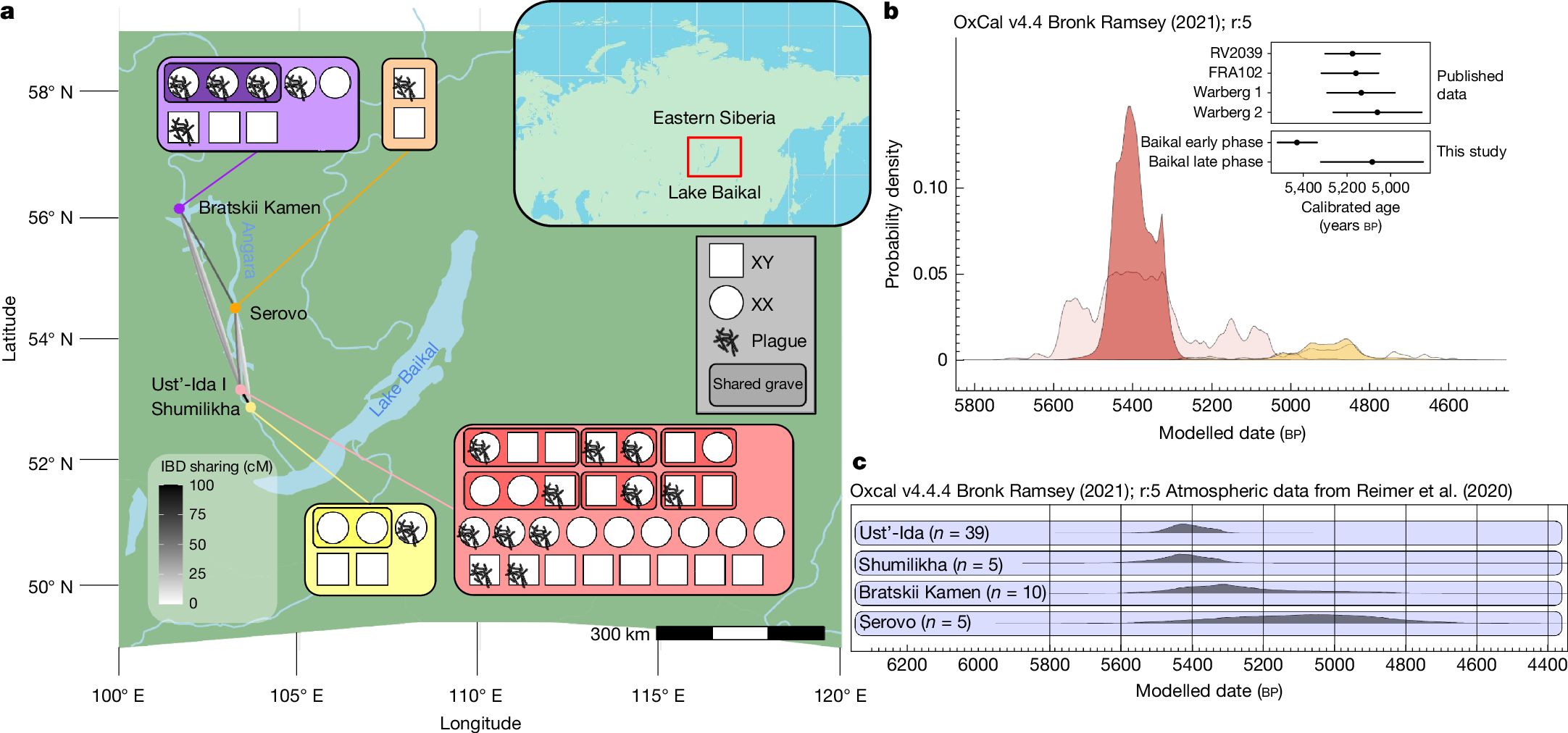
◆Nature誌に発表された研究では、シベリア・バイカル湖周辺の4か所の墓地から出土した人骨を対象に古代DNA解析を実施し、ペスト菌(Yersinia pestis)の初期系統ゲノムを復元した。その結果、46人中18人(約40%)からペスト菌DNAが検出され、多数の子どもや若年者が短期間に死亡していたことが判明した。放射性炭素年代測定や親族関係解析から、家族単位での死亡例も確認された。さらに、これらの初期ペスト菌は、後世のペストには見られない「スーパー抗原」と呼ばれる毒性因子を保有しており、強い免疫反応を引き起こして重症化を促進した可能性が示された。
◆研究は、ノミ媒介による伝播機構が確立する以前からペストが高い致死性を持っていたことを示し、ペストの起源や進化、ユーラシア大陸への拡散過程に新たな知見を提供している。
<関連情報>
- https://news.ku.dk/all_news/2026/06/oldest-strains-of-plague-caused-deadly-outbreaks-5500-years-ago/
- https://www.nature.com/articles/s41586-026-10540-5
5500年前、バイカル湖周辺の狩猟採集民の間で致死性のペストが流行した Lethal plague outbreaks in Lake Baikal hunter-gatherers 5,500 years ago
Ruairidh Macleod,Frederik V. Seersholm,Bianca De Sanctis,Angela Lieverse,Adrian Timpson,Rick Schulting,Jesper T. Stenderup,Charleen Gaunitz,Lasse Vinner,Olga Ivanovna Goriunova,Vladimir Ivanovich Bazaliiskii,Sergei V. Vasilyev,Erin Jessup,Yucheng Wang,Christopher Bronk Ramsey,Mark G. Thomas,Russell Corbett-Detig,Astrid K. N. Iversen,Andrzej W. Weber,Martin Sikora & Eske Willerslev
Nature Published:17 June 2026
DOI:https://doi.org/10.1038/s41586-026-10540-5
Abstract
Plague is among the most devastating diseases in human history1. However, early strains of the plague-causing bacterium Yersinia pestis lacked virulence factors that are required for the bubonic form until around 3,800 years ago2,3. Consequently, the morbidity and mortality of early plague strains remain unclear. Here we describe early plague strains that are associated with two phases of outbreaks among mid-Holocene hunter-gatherers near Lake Baikal in southeast Siberia, beginning from about 5,500 years ago. These outbreaks occur across four hunter-gatherer cemeteries, with a 39% detection rate for plague infection. By reconstructing kinship pedigrees, we show that small familial groups were affected, consistent with human-to-human spread of disease, and that the first outbreak occurred within a single generation. The infections appear to have resulted in acute mortality, especially among children (aged 8 to 11 years). We further note functional differences, including in the ypm superantigen locus, which is also present in present day Yersinia pseudotuberculosis. The new strains diverge ancestrally to known Y. pestis and constrain the timing of its emergence, indicating that this happened before approximately 5,700 years ago. These findings show that plague outbreaks happened earlier than previously thought and were indeed lethal. We contend that the occurrence of outbreaks among mid-Holocene hunter-gatherer communities well outside the sphere of Late Neolithic Europe challenges the notion that higher population densities and lifestyle changes during the Neolithic agricultural transition were prerequisites for plague epidemics.