2026-08-12 中国科学院(CAS)
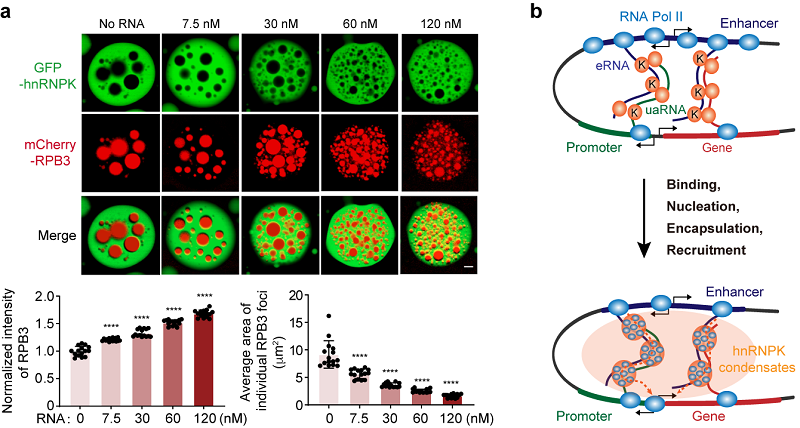
HnRNPK condensates promote enhancer-promoter looping and Pol II recruitment. a. Pooled eRNAs and uaRNAs enhance the encapsulation of RPB3 within hnRNPK phase-separated cavity-containing condensates; b. Schematic model illustrating hnRNPK-mediated transcriptional regulation. (Image by XUE Yuanchao’s group)
<関連情報>
- https://english.cas.cn/newsroom/research-news/202608/t20260818_1187971.shtml
- https://www.nature.com/articles/s41588-026-02710-y
hnRNPK凝縮体はエンハンサー-プロモーターループ形成とRNAポリメラーゼIIのリクルートを促進する hnRNPK condensates facilitate enhancer–promoter looping and RNA polymerase II recruitment
Rong Ye,Hailian Zhao,Juan Chen,Qigui Wu,Di Wang,Zhaokui Cai,Ruoyan Wang,Jingxin Li,Tiantian Cheng,Ming Zhang,Wanglong Liu,Ruiyun Yang,Jie Zhou,Zhen Yuan,Bowen Liu,Changchang Cao,Shuoji Zhu,Xing Li,Jinsong Li,Tengfei Zhang,Ping Zhu & Yuanchao Xue
Nature Genetics Published:12 August 2026
DOI:https://doi.org/10.1038/s41588-026-02710-y
Abstract
Enhancer RNAs interact with promoter-derived RNAs to dictate enhancer–promoter looping, but the RNA-binding protein that mediates this process has remained unidentified. Here we identify hnRNPK as a general structural regulator that preferentially binds to nascent RNAs transcribed from enhancer and promoter regions, promoting enhancer–promoter looping and transcriptional activation. We further show that hnRNPK forms phase-separated, cavity-containing condensates that encapsulate RNA polymerase II (Pol II) via its RPB3 subunit, facilitating chromatin looping and potentially enabling recruitment of Pol II from enhancers to promoters through protein dimerization. Notably, a mutation associated with Au–Kline syndrome in hnRNPK (c.953+1dupG) alters its condensates from a liquid-like to a gel-like state, leading to developmental defects in knock-in mice. Fibroblasts derived from these mutants display reduced enhancer–promoter looping and decreased Pol II recruitment at promoters of key developmental genes. These findings suggest that hnRNPK is a structural regulator of enhancer–promoter communication and highlight the importance of RNA–RNA interactions mediated by RNA-binding proteins in transcriptional regulation.