2026-08-03 愛媛大学
<関連情報>
- https://www.ehime-u.ac.jp/data_relese/pr_20260803_sci/
- https://pubs.rsc.org/ra/article/doi/10.1039/d6ra03733j/1285886/Machine-learning-based-molecular-detection-using
暗視野観察を用いた2種類のナノ粒子の機械学習に基づく分子検出
Machine learning-based molecular detection using dark-field observation of two different nanoparticles
Yuki Yano;Gen Hirao;Ryosuke Izumi;Yu Muto;Misato Yasuoka;Tsuyoshi Asahi;Takuo Tanaka;Mizuo Maeda;Tamotsu Zako
RSC Advances Published:31 July 2026
DOI:https://doi.org/10.1039/d6ra03733j
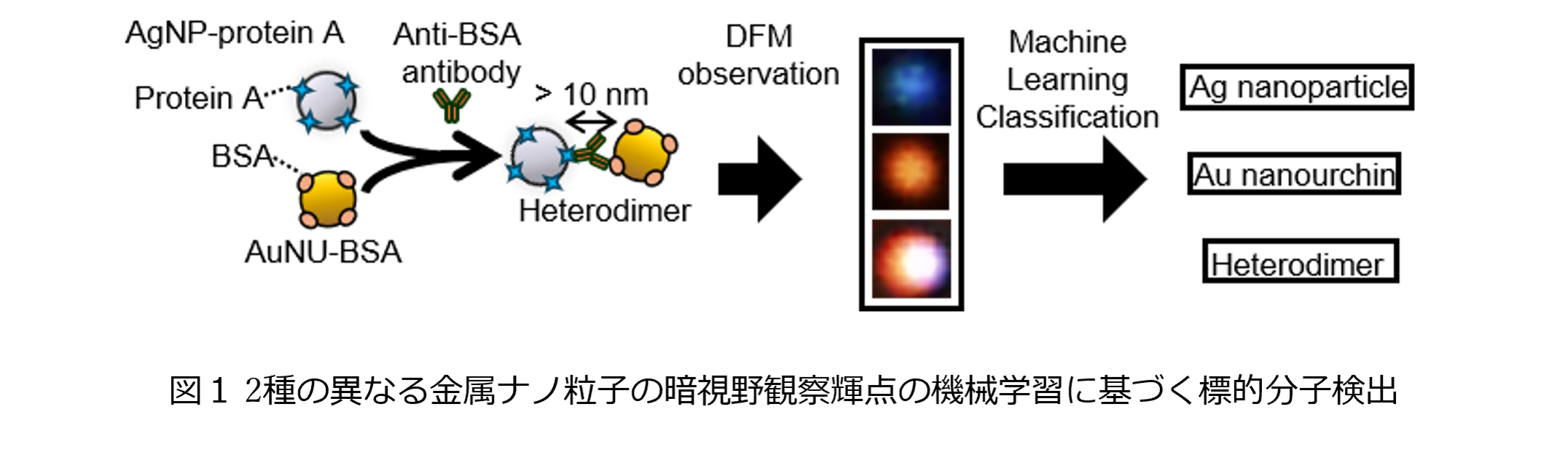
Metal nanoparticles, such as gold nanoparticles (AuNPs), are widely used as biosensing materials. In previous studies, dark-field microscopy (DFM) has been utilised to examine target-induced AuNP aggregation for molecular sensing. The intensity of scattering light of each spot observed by DFM was analysed at the single-cluster level for sensitive molecular detection. However, changes in the intensity and colour of AuNP aggregates were not significant when the inter-particle distance was large because of the insufficient effect of the surface plasmon resonance, suggesting difficulty in the sensitive detection of large molecules such as proteins. In this study, we developed a machine learning-based method to distinguish target-induced dimers from monomers by DFM, given large inter-particle distance, using two types of nanoparticles with different spot colours. When the two types of nanoparticles form a dimer (heterodimer), observation of a new spot colour derived from the heterodimer could be expected. As a proof-of-concept study, Protein A-modified silver nanoparticles and BSA-modified gold nanourchins were used to detect anti-BSA antibody; in the presence of the target, heterodimer was formed. The colours of individual spots observed by DFM at the single-cluster level were utilised for machine learning-based classification, and spots derived from heterodimers were identified for molecular detection. Our results demonstrate that the heterodimer formation increased in a target concentration-dependent manner. Furthermore, scattered lights from non-specific aggregates and impurities such as dust can be discriminated by this method. This assay is expected to be applicable to the detection of large molecules, such as proteins.