2026-07-27 北海道大学
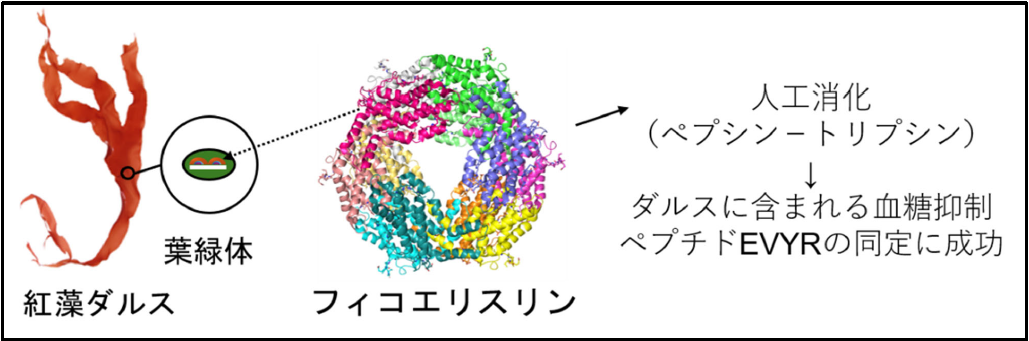
紅藻ダルスの主要タンパク質であるフィコエリスリンに血糖コントロールに関わる酵素DPP-IVの働きを阻害するペプチドを同定した。
<関連情報>
- https://www.hokudai.ac.jp/news/2026/07/post-2381.html
- https://www.sciencedirect.com/science/article/abs/pii/S2212429226009739
紅藻ダルス由来のジペプチジルペプチダーゼIV阻害ペプチドの同定及びin vitro消化ダルス粉末における標的ペプチドの定量 Identification of dipeptidyl peptidase-IV inhibitory peptides from red alga dulse (Devaleraea inkyuleei) and quantification of the target peptide from in vitro digested dulse powder
Yuya Kumagai, Martin Alain Mune Mune, Yuji Shinohara, Tadashi Hatanaka
Food Bioscience Available online: 3 June 2026
DOI:https://doi.org/10.1016/j.fbio.2026.109201
Highlights
- DPP-IV inhibitory peptides were obtained from pepsin–trypsin digested dulse protein.
- A novel DPP-IV inhibitory peptide EVYR was identified.
- EVYR exhibited DPP-IV inhibitory activity with an IC50 of 327 μM.
- EVYR was quantitatively detected in the pepsin–trypsin digest of dulse powder.
- Red algae consumption may provide dietary DPP-IV inhibitory peptides.
Abstract
Dipeptidyl peptidase IV (DPP-IV) inhibitory peptides play an important role in the prevention of diabetes. However, knowledge of seaweed-derived peptides remains limited. In this study, we evaluated the DPP-IV inhibitory peptide from the in vitro and in silico digestion of red alga dulse in Japan. The phycoerythrin (PE) α- and β-chains, a major protein in red algae, were heterologously expressed in Escherichia coli, followed by simulated in vitro pepsin–trypsin digestion. In silico analysis was also conducted to predict DPP-IV inhibitory peptides from the amino acid sequence of PE. As a result, the peptide EVYR was identified, exhibiting an IC50 value of 327 μM. Furthermore, EVYR was successfully quantified in pepsin–trypsin digestions of both dulse powder and its water extracted dulse protein, with contents of 41.3 ± 4.0 μg/100 mg and 386 ± 35 μg/100 mg, respectively. Sequence analysis revealed that EVYR is conserved among various red algal PE α-chain. In silico pepsin–trypsin digestion suggested that EVYR was released from all red algal PE tested. To our knowledge, this is the first report quantifying a bioactive peptide generated from algal digestion. These findings suggest that peptides released from dulse during digestion may serve as promising functional food ingredients for glycemic control.